History will remember that two neighborhoods fought against two hegemonic states.
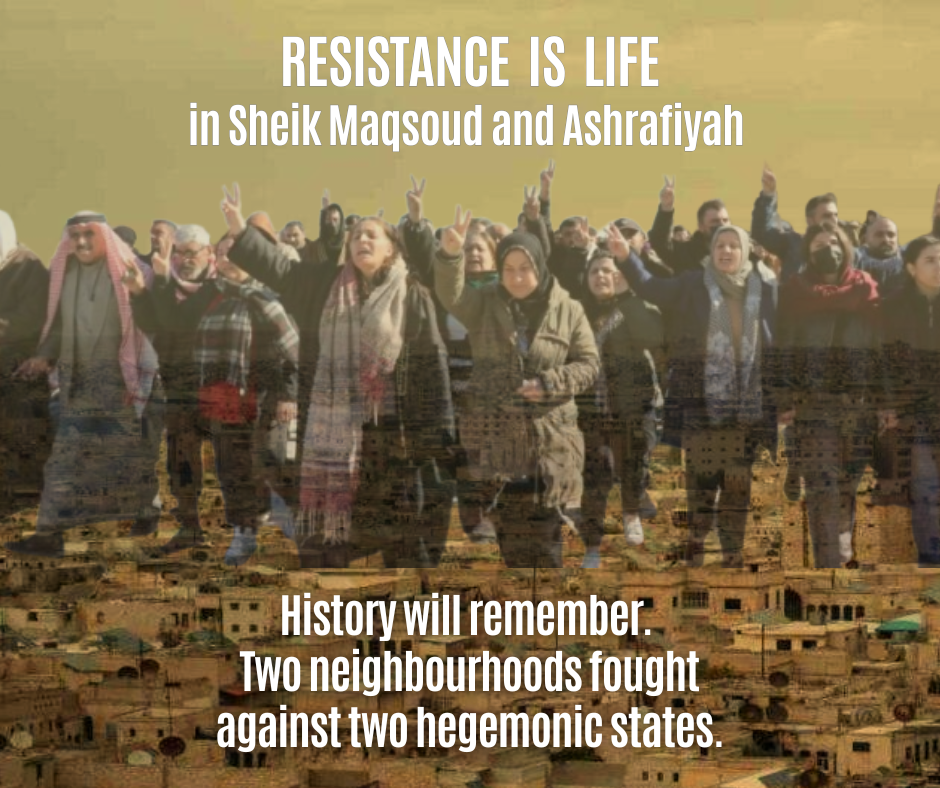
Resistance is life. Berxwedan jiyan e. This phrase is a philosophy in North and East Syria, everyone shouts it in the streets, during demonstrations or in everyday conversations. Resistance is the protection of life, of existence. It is about protecting one’s land, identity and culture. To resist means to protect and create, to give life.
In recent days, we have experienced great moments of resistance. Life has once again been attacked in Aleppo, in the majority Kurdish neighbourhoods of Sheikh Maqsoud and Ashrafiyah. And in the face of these attacks, society has resisted. On 7 January, mercenaries affiliated with Syria’s interim government launched an offensive supported by the Turkish state, with bombing, heavy artillery and tanks. The self-defence forces and society as a whole decided to stay and protect their neighbourhoods. They defended the land with great honour.
This resistance is continuing the history of these two neighbourhoods:
Sheikh Maqsoud and Ashrafiyah have been the scene of major demonstrations and uprisings, such as those in March 2004, when people threw stones and set fire to regime vehicles and, during the Newroz celebrations, defied the siege and forced the regime’s security forces to retreat. Şehîd* Yekta Herekol carried out an act of self-sacrifice, burning himself in the centre of Aleppo to protest against repression, thus becoming a symbol of resistance.
Over the last 25 years of siege, bombing and fires, these neighbourhoods have been a bastion of dignity. And their strength and determination have been demonstrated once again in recent days. On January 11, a partial ceasefire has been declared to prevent further massacres and to evacuate civilians, children and the wounded from the hospital to safe areas within the Democratic Autonomous Administration of North and East Syria.
But this is not a surrender. It is not a bowing down. The resistance and the struggle continue.
The resistance of these two neighbourhoods over the last week has seen 300 comrades, part of the Internal Security Forces, challenge around 42.000 soldiers of two nation-state armies, that of Damascus, supported by the United States, and that of Ankara (one of NATO’s largest armies). In Sheikh Maqsoud and Ashrafiyah, what was fought against was the mentality of power, fascism, domination and war, which wants death to prevail. The population decided to stay, the internal defence forces fought: and it is clear that they did so to build life and beauty in opposition to their death. They did not resist only for their own self-defence, but in resistance for all humanity.
History will remember that two neighbourhoods that fought against two hegemonic states.
Our comrades were ready to give their lives; they were ready to make self-sacrifices, to fight the mentality of power and they showed the world that resistance is truly life. The commander Şehîd Ziyad Heleb and the self-sacrifizing fighters Şehîd Denîz, Şehîd Dilbirîn, Şehîd Faraşîn, Şehîd Rojbîn and Şehîd Hawar thus became martyrs. These comrades, as the vanguard of society, kept their promise of defence to the end: they had said they would protect the land, culture, identity and society and their fellow comrades, and they put this into practice. They did not betray, they did not turn their backs, they did not abandon their people. They are the spirit of socialism today. They promised freedom and followed the same path as so many other martyrs. They embodied the memory of the martyrs of this movement and of the partisans of all ages.
These five comrades are like the fire of Şehîd Mazlum Dogan, who, faced with torture and betrayal in Diyarbakir prison, decided to burn his own skin and to send an indelible message by writing the phrase ‘Resistance is life’ on the walls of his cell in 1982. And these comrades of Aleppo embody the same determination as Şehîd Zîlan, who carried out an act of self-sacrifice during a Turkish army military parade, during the period of the international conspiracy against Rêber Apo (Abdullah Öcalan) in 1996. Her action was aimed at defending Rêber Apo, which is equivalent to defending the existence and resistance of the Kurdish people.
There is a thread that unites these actions: the rejection of betrayal, the defence of society and life.
People from across the Democratic Autonomous Administration of North and East Syria reacted without hesitation: convoys of hundreds of cars and buses from all cities set off in support of the resistance. Morale in society and among the people remained high. Faced with all this, how can one not have hope?
Rêber Apo states that ‘Hope is more valuable than victory’. The Kurdistan Liberation Movement is a movement of hope. Because whatever the outcome of an action, we will continue to have faith in the future and to put effort into every step. In 1980, after the military coup in Turkey, most of the leaders of the Kurdistan Workers’ Party were arrested. About 80% of the leaders were imprisoned or left the country. Rumours circulated that the PKK was finished. But despite all the difficulties, resistance was organised in the prisons and, in the meantime, hard work continued under extremely difficult conditions until 15 August 1984, when the formation of a guerrilla movement was announced. This is the potential of this movement: to have hope and solid ideals, to work hard to achieve the right goals.
The resistance in Kobanê also shows us this: the comrades had only one neighbourhood under their control, conditions were not easy and there were martyrs every day, but with commitment and hope they managed to liberate the entire city and area. And they were the first to defeat ISIS.
Of course, these are difficult times. There has been a massacre, everyone in Sheikh Maqsoud and Ashrafiyah has lost family members or loved ones, there are wounded and many displaced persons.
But as Şehîd Têkoşer Piling says: ‘Do not give in to resignation, do not abandon hope; never! Not even for a moment. Even when all seems lost and the evils afflicting mankind and the earth seem insurmountable, try to find strength and instil it in your comrades. It is precisely in the darkest moments that your light is needed.’ The Italian revolutionary Şehîd Têkoşer joined the YPG (People’s Protection Units) precisely to fight against ISIS, to combat the same fascist mentality that lives on today in the mercenary groups attacking Aleppo and the Autonomous Administration. He became a martyr in 2019, and his words still guide us today. Indeed, it is clear that now is the time to open our hearts to hope and trust that life will prevail.
Let us conclude with words of intense humanity. They are the words of a young woman, a fighter and comrade in Aleppo who, before going into action and sacrificing herself, emphasised the significance of taking action: ‘We carry this mission on our shoulders, until the last drop of our blood, until our last breath, we will continue to resist. For the people of this country, for the children of this country, for the sacrifices, pain and suffering endured on this land, we will protect the children of our future. We will become the sacrificial fighters of this country.’ The resistance of Aleppo was a resistance that protected the dignity of the people and will go in the history of Revolutionary People’s War, that will enlighten our way to struggle even harder in the future. We commemorate all the fighters and all the civilians, who sacrificed themselves and created great revolutionary values with their determination and their spirit.
Long live the resistance of Sheikh Maqsoud and Ashrafiye!
Long live the Revolutionary People’s War!
Long live Rêber Apo!
* Şehîd: is a Kurdish term referring to ‘martyr of the revolution’.