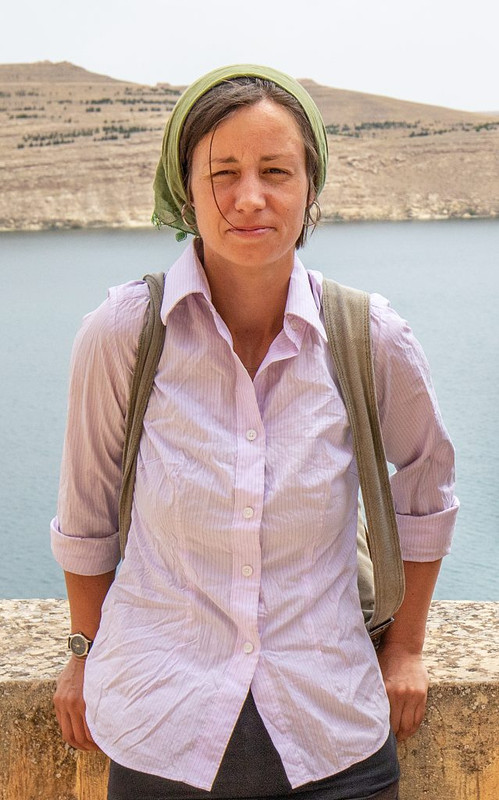
Sara Dorşîn (Sarah Almuth Handelmann) was a German revolutionary who joined the ranks of the PKK guerrillas in 2017, driven by her commitment to socialist ideals and feminist principles. Through her studies and her political activism at the time, she went to Amed (Turkish: Diyarbakir) and shot the film “Xwebûn” there about the Kurdish resistance. On 7 April 2019, she fell as an internationalist martyr, together with other comrades in the mountains of Kurdistan, in the Medya Defense Zones, as a result of the Turkish army’s bombardments.
During her time in the free mountains of Kurdistan, she wrote a letter addressed to the internationalist youth, describing the significance of internationalism and calling for a clear stance on taking responsibility. Several years have passed since then, yet Şehîd Sara’s words still strike at the heart of the urgent needs of our time. We must once again engage with the building of hope and faith, which serve as signposts against the power monopolies of the Third World War – in which we still find ourselves. We wish to carry on Şehîd Sara’s faith, allowing theory and practice to merge, and thus commemorate her today, 7 April, the day of her martyrdom. This day is meant to mark the awakening of all revolutionary cells.
“We are at war. That is a clear fact, as serious as it is commonplace. This has been our life ever since we began searching for something we could not find in our immediate surroundings, or at least believed we could not. And this is what has become of this war: it is not easy to believe in anything today. I reckon that’s become an excuse – faith. We must turn what we do into something we can believe in. That means it is our own actions that generate value and faith – and then, in turn, through our belief in them, give them the strength needed to be credible and resistant. So, that means acting, getting started, doing something, being in motion, rather than waiting for something to come along that already fulfills our idealistic aspirations in every respect, or despairing that this is not the case, cannot possibly be the case. There is already a mistake here. For the point is that our endeavor MUST be impossible. If it does not go beyond the limits of what is feasible, it cannot possibly live up to a radical claim. The worst thing is that we have forgotten how to walk the path we actually believe to be right. We allow our instincts to follow our rebellion to wither away, as we are too preoccupied with calculating the outcome of a potential struggle; we even convince ourselves that this gives value to our actions.
In doing so, however, we miss out on the genuine experience of resistance that draws its strength from within itself. Value always arises in the struggle. The same applies to freedom.
So I can say: ‘this is freedom’, yet at the same time I can never claim to be free myself. A liberated society does not mean that the struggle is over. A liberated society is a society that fights for freedom, a society that is liberating itself. (Also) freedom lies in the struggle itself. And that is a path, a movement in the awareness that history is something we can influence. We must work on our attitude. We have no right to fail. As militants, as revolutionaries, we have no right to do so. (Yet another problem of liberalism). We grant ourselves too much leeway to fail. Blaming circumstances, blaming ourselves. We even take pleasure in our own inadequacies. We have learnt to do so in order to be able to love ourselves at all. For others, we call it understanding or compassion. In reality, by doing so – through a lack of radicalism and by making excuses – we rob ourselves of the strength to wage any successful struggle. We deprive ourselves of our radicalism. We limit ourselves. The truth is this: if something is unsuccessful, if we fail, it is solely down to our own mistakes. Nothing or no one else is to blame. It is a question of aspiration and will. For the struggle knows no bounds. This attitude not only embodies our task, but is also our advantage. Because it simultaneously means that we will succeed if we make no mistakes. That is to say, do not hide mistakes and work on oneself, change. The human being themselves is the success. So, the individual is also a guarantee. And the individual is also a goal. In this sense, there is actually nothing we cannot do, no struggle we cannot fight. We are talking here of radicalism.
War is being waged against us, and that is an everyday reality which, however, has only partially penetrated our consciousness. Naturally, it takes various forms. It has always been so. As we know, violence is a favored means that also takes many different forms. The state authority calls itself by this name and is also keen to resort to psychological measures. But there is more: with this violence, you may break the will, but with a system such as that practised by the so-called democratic states in the West, you ensure that the will does not arise in the first place. This actually works very well. So how many of us can actually claim to be willing to put something on the line, to make a sacrifice?
At the same time, however, there is the search for meaning. There is a deep longing within people to commit themselves to something greater.
We are at war … It is time for internationalism. When I go into the mountains today, learn to handle a Kalashnikov, read the books of Abdullah Öcalan and discuss feminism with young guerrillas, I do not do so because I have succumbed to an Orientalist notion and think I am helping an oppressed people to liberation. Ultimately, I do it because I know I cannot claim to promote any values if I do not fight. And because the weapons being supplied to the Middle East are of German manufacture.
Values are always forged in struggle! A theory is always incomplete without practice! We lack a sense of seriousness that does not despair, but believes in itself! We are part of a global struggle against the same enemy. This war, which we call the Third World War, is above all an ideological one. If we win, it will be a victory over a great depression. But if we fail, an even greater despair will descend upon precisely those who may now be watching with interest, yet are unable to fight actively on the militant side.
But to fight means we cannot lose; it means we have already won the moment we truly begin to fight.
This war is our war, our responsibility, our decision and our resolve.
So why do we so easily forget that we are at war?”
– Sara Dorşin, Mountains in Southern Kurdistan 2018–2019
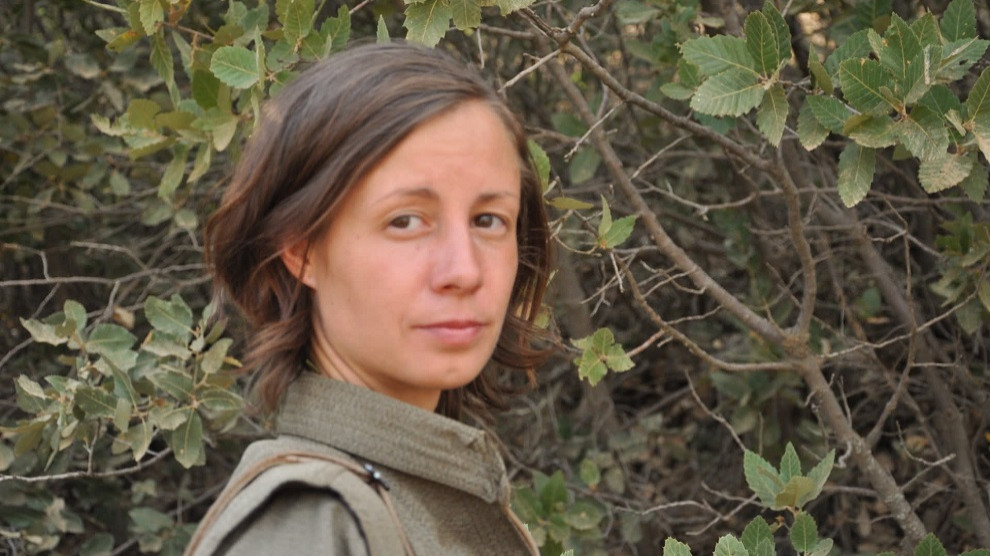
A song written by Women Defend Rojava, dedicated especially to Şehîd Sara Dorşîn:
Comrade Sara,
your struggle for freedom was international,
Comrade,
your path led to Kurdistan,
and then,
you went into the mountains
and were with the Hevals,
where your struggle as a militant began.
[Chorus]
A guerrilla who was
determined and brave,
among trees and mountains
her heart beat full of rage and full of love,
for the revolution and for life
that was resistant.
Sara, comrade,
xwebûn, xweparastin – you were so clear
Comrade,
it was the longing within you,
namely,
the search for a life of dignity,
for which you then gave everything.
[Chorus]
Sara, comrade,
you felt your responsibility,
comrade,
and followed it to the very end,
yes, then,
you sought the truth,
felt and acted,
no path was too far.
[Chorus]
Sara, comrade
Your deeds are not yet complete today,
comrade
There are many memories of you,
oh yes,
They will stay with us
and we will pass them on,
‐ and see you as our role model.
[Chorus]
Sara, comrade,
your dreams guide us,
they give us hope,
comrade
they are the hope within us,
so clear, together we will carry them forward
‐ so you will never leave us!
[Chorus]
Şehîd Namirin – The martyrs enlighten our path.