
This interview was conducted at the end of December 2025 with an Arab friend, whom we have referred to here as Zîlan, who was in the Zap region¹ with Heval Tîjda until she fell in battle.
About our first meeting: Due to the journey, and also because of the conditions in the Zap region, comrades arrive in winter depending on the weather. When I first saw Heval Tîjda, she was completely soaked. They had walked through a lot of water and her luggage had been very heavy too. They had faced many difficulties; the journey was very long. When reinforcements arrive, comrades—both women and men—have to carry at least 50 to 60 kilos. Whether you like it or not, that’s physically very demanding, and normally you’d say something when you can’t go on. But with Heval Tîjda it wasn’t like that; no matter how much difficulty she had, she didn’t let on. She had a strong will to learn and worked hard. […]
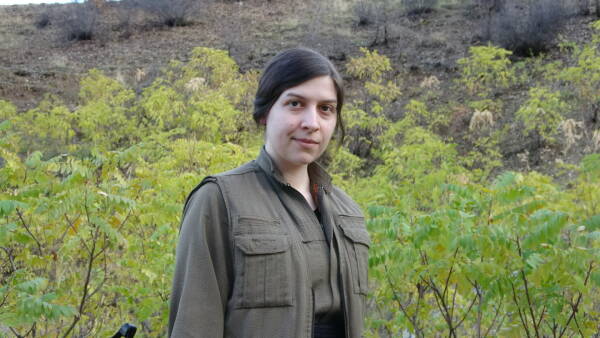
Heval Tîjda was a sniper. When her comrades told her she was going to the Zap region, she danced with joy, she wanted to go there so much. And we all know that the war in Zap was extremely tough. The enemy’s technical and psychological warfare was extremely intense. Because the enemy suffered many heavy blows here, many of its soldiers died here, and our comrades publicised all of this, the enemy wanted to kill all our comrades. The enemy did not want to allow the experience gained in Gundê Fileh² and throughout Zap, regarding precautions against chemical and technical warfare, to be passed on, nor did it want the comrades who had gained this experience to come out alive. As an internationalist, Heval Tîjda wanted to take her place in this resistance and indeed did play a significant role. […]
In her assessments, you could sense that she had truly internalised the movement’s culture. Some friends, for example, hurt others with the way they judge them, but Heval Tîjda, however harsh her criticism might have been, spoke in such a way that you found yourself thinking: ‘I will really take this criticism on board and pay attention to what Heval Tîjda has said.’ Because she spoke in an organised way. No matter how much she criticised, I was never angry, because on the one hand she criticised, and on the other she built people up; she didn’t allow anyone to break down in the midst of war and not get back up. You can really describe the friendship with Heval Tîjda like this: she was a true friend. When she first arrived, she was desperate to go out and work. We had to use the winter to procure supplies and petrol. But the comrades wouldn’t let her come along because she was new; the conditions in Zap are different from those in Garê³, the technology the enemy has deployed here is very advanced, you have to be extremely careful. […]
We tried various things to find another role for Heval Tîjda, and then we decided the best thing would be to make her in charge of logistics [for the supplies], but then she said that if she was the one in charge, she would have to go and fetch the supplies herself. And she was successful in this; she played a very active role throughout the whole operation, our Heval Tîjda. […] She achieved what she had set out to do, and the comrades sent her out as well. And the first time, they really struggled, because Tepê Bihar⁴ is really very high and steep; the terrain is very difficult. Anyone who doesn’t appreciate Tepê Bihar will struggle there, but for those who learn to love this mountain, it will be a piece of cake. And Heval Tîjda really did learn to love Tepê Bihar; she had a great love for nature. She could even see meaning in the stones there; she regarded them as living things, and she saw the flowers as living beings too and spoke to them. […]
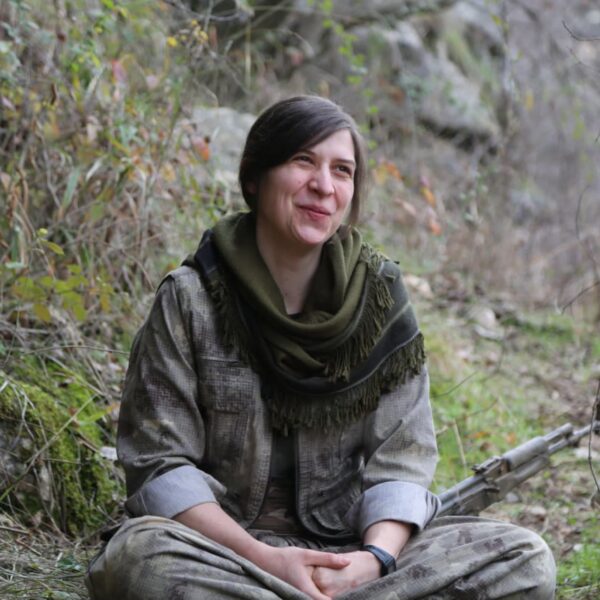
Whenever there were tasks to be done, Heval Tîjda was always the first to put her hand up; she was the same in education too – she would start discussions to help us reach our goal, and she never had any doubts about it. You know, often when you’re discussing something, you think to yourself: ‘Maybe I’ll say something wrong, maybe it’ll be misunderstood’, and then we shut ourselves off. But Heval Tîjda wasn’t like that. Whether right or wrong, she said what was on her mind. That’s why everyone was inspired by her and wished they could be like her. Her heart was like a child’s heart, so pure. She embraced everyone around her with it. She has a very big heart. […]
She wanted so much to hear Serokatî’s voice, and very often I find myself thinking: ‘I wish Heval Tîjda could have seen Serokatî’s voice and videos.’ That was her greatest wish, and that was what she fought for. She wanted to share that joy with all her friends. One of the first things that went through my mind when we saw the recordings of Serokatî was our fallen friends, and especially Heval Tîjda. […]
Her diary meant everything to her; her whole life is in there. After Heval Tîjda was killed, her friends initially wanted to get her diary out, but everyone said it wasn’t possible. Because I was so close to her, I said, ‘Even if I’m killed myself, I have to get it out, for her mother, who loved her so much’ […]
Her diary and her scarf […] were the most precious things to me, because what she thought about most was her mother. I love Heval Tîjda very much. Perhaps I cannot love her as much as her mother did, but to me she is someone very special. Heval Tîjda loved her mother very much. And out of my love for Heval Tîjda, I want her most precious belongings, her scent, to reach her mother; that had also been her wish. She was truly a very special person; I sometimes find it difficult to talk about her. I remember one time when the enemy had advanced as far as Ortê Alan⁵. As a result, some of our friends fell there; one of them was Heval Şervan. They had completed the basic training of the Hêzên Taybet⁶ together. Two comrades, Heval Mazlum and Heval Şervan, who had been in training with Heval Tîjda, had stayed behind in Girê FM⁷ and did not reach us. The enemy had picked up their radio communications and immediately deployed forces there. At first, the comrades made no sound; they had hidden in a cave.
The enemy forces are advancing towards them, including a commander. A battle ensues; the friends kill the commander, but the enemy now knew their location and struck accordingly. Both friends were killed. This only fuelled Heval Tijda’s anger further, for Heval Servan meant the world to her. But they never saw each other again. He always said, “We’ll see each other again,” but they didn’t. The friend fell on his way to us; he never reached us. […]
When Heval Tîjda spoke about this and shared her feelings, she said, “I cannot take revenge if I’m always crying, hiding away, staying on the sidelines, not eating, not taking action. I cannot avenge her death like this; I’m doing her an injustice.” That was her approach. Then the comrades said the sky was overcast, so actions could be carried out. Heval Tîjda was chosen so that she wouldn’t suffer under the pressure of not having been able to defend Heval Servan. The distance between us and the enemy had been too great, and no matter how many bullets Heval Tîjda fired, they couldn’t reach the enemy. That really got to her; she hadn’t been able to defend her comrades and they had fallen. When the comrades then said, ‘We’ll take revenge and attack the enemy,’ they immediately included Heval Tîjda in the plan. She was so happy. […]
Heval Tîjda was so tall, but when she jumped for joy, she seemed so light. She could have embraced the whole world; no one could stop her, neither friend nor foe, she was so happy. We always used to joke, saying, ‘The enemy saw you from afar and got scared.’ Because when our friends set off to carry out the action, the enemy’s forces had fled; they knew our friends were going to attack. We always joked: ‘The enemy saw you coming.’ […]
I lived with a few internationalists, but in our case, we—an Arab woman and a German woman—became as inseparable as could be; it was the sort of friendship where our origins, our nationalities, our characteristics never stood between us. Our friendship didn’t allow for any boundaries between us, for anything to separate us; we were that deeply bonded. We loved each other so much; I played her Arabic music and she played me music in other languages; we didn’t understand a word of each other’s music, but we listened to it together anyway. We were exactly the same height, so we usually danced side by side. Sometimes I’d look at her and think she danced better than the Kurds themselves; she had so much motivation and spirit. […]
______________________________________________________________________________________________________________________________________
¹ The Zap region is located in South Kurdistan on the border with Turkey. It is named after the Zap River, which flows through it. It is one of the central Medya defense zones.
²Gundê Fileh is a region part of the Medya Defense Region
³Garê is a region in South-Kurdistan, close to Dohuk, an important region for the guerilla
⁴Tepê Bihar is a mountain in the Zap region where the guerrillas have dug tunnels and caves for defense
⁵Ortê Alan is an area within the Medya Defense Zones
⁶Hêzên Taybet (Special Forces) is a unit within the HPG composed of specially trained fighters. To become part of these forces, a high degree of ideological depth and conviction is required. The Şehîd Zîlan unit, which comprises fighters preparing for a fedayi operation, is also part of the Hêzên Taybet
⁷Girê FM is a mountain in the western part of the Zap region