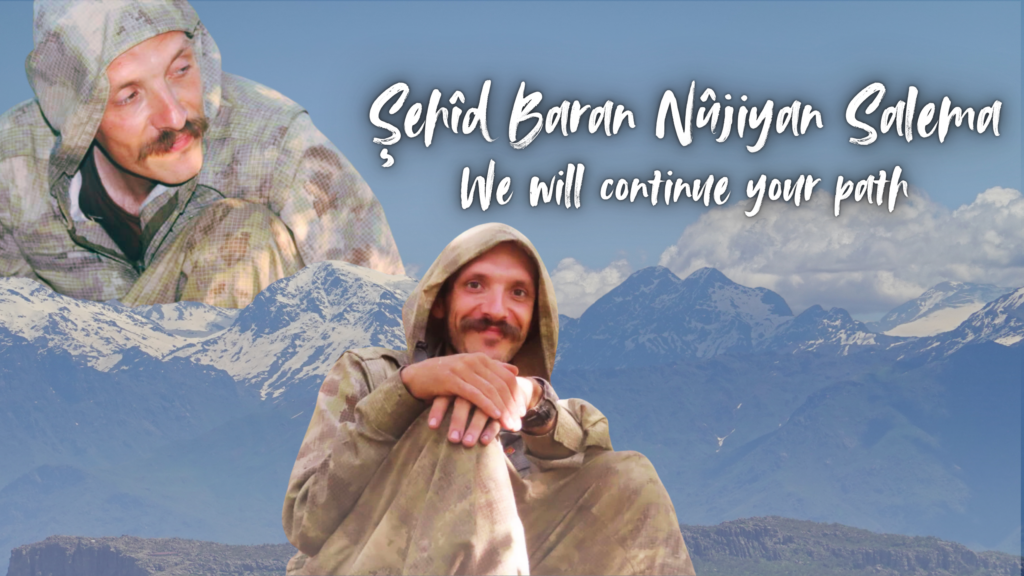
As announced by the HPG (Hêzên Parastina Gel) press office on 25 September 2026, the internationalist Pablo Manuel Figueiras Duarte, nom de guerre Baran Nûjiyan Salema, lost his life in Qendil on 6 August 2025.
Today we would like to commemorate a friend who dedicated his life to his convictions and the struggle for freedom.
Heval Baran was born on 3 October 1990 in West Germany to a German mother and a Portuguese father.
Everyone who knew him is aware of his life-affirming attitude, his curiosity and his seemingly boundless energy, which often brought people from very different backgrounds together.
His path to the revolution, the struggle in Kurdistan and the Apoist movement took him through many stages, yet even as a child he often asked himself why we live the way we do.
Heval Baran discovered a passion for cooking at an early age and, thanks to his love of experimentation, creativity and friendliness, always brought people together around a shared dining table. Sharing meals and moments together was always deeply meaningful to him.
Although he could have embarked on any academic career after completing his higher education qualifications, he turned his love of cooking and the joy that he could bring people through food into his profession.
He trained as a chef in Portugal and, within a short time, was working in high-end restaurants. His ambition and determination were the key to his success, both then and later. Over time, however, Heval Baran began to feel a deep sense of contradiction with his profession – cooking for a small section of society, for the few who could afford it. Questions about the meaning of life and the purpose of his work continued to weigh heavily on his mind.
Eventually, he decided to leave this chapter of his life behind, to travel and to seek answers to his questions.
Back in Germany, he spent some time involved in anarchist circles, took part in the protests surrounding the G20 summit in Hamburg, and explored the movements behind the Hambi occupation and EndeGelände. However, he felt there was a lack of a holistic perspective, which he could not find there despite all the idealism he perceived in these movements. He found this missing perspective in the writings and paradigm of Abdullah Öcalan. In the wake of the protests and solidarity actions against the Turkish war of aggression in Afrîn, he got to know the Kurdish freedom movement and, through it, the revolution in Rojava. The desire to see this real alternative to the state and capitalism with his own eyes led him to travel to Kurdistan in the summer of 2019. In northern Iraq (Southern Kurdistan), he had the opportunity to meet the guerrillas in the mountains for a short time. It was there that he found the clearest answers to the question ‘How should we live?’. He decided to stay there, to learn from the movement and to defend the mountains side by side with Kurdish, Turkish and internationalist comrades from all over the world against the attacks by the Turkish state’s NATO army. During this time, too, he engaged in extensive discussions on an internationalist perspective and developed proposals on how the Kurdish Freedom Movement could, in very practical terms, contribute to strengthening democratic forces across the world.
In Garê (a region/guerrilla territory in South Kurdistan), where he had completed his basic training, he learnt quickly and, in a very short space of time, developed into a professional guerrilla fighter who, through his selflessness, his tireless commitment and his friendship, became a role model for many of us. He himself said of joining the PKK and the guerrilla movement: “That was a huge step. First of all, you get to know yourself – that was a very powerful experience. I came here from a completely different place, a completely different life. The effects of liberalism and capitalism are most advanced in Germany. So much filth. Here (in the party), I realised just how much we need to develop further and that we can overcome these things.”
On the 21st of April 2021, large-scale military operations by the Turkish army began in Metîna, Zap and Avaşin, with the stated aim of crushing the guerrilla movement. Heval Baran wanted to take his place in the defence of the region immediately. However, in order to develop his skills and prepare himself, he was sent to the Şehîd Mahir Academy, where he deepened his knowledge and completed specialist training in the field of sabotage. In 2022, upon completing his training, his request to go to Metîna and take part in the defence on one of the fiercest fronts against the Turkish state’s annihilation attacks was granted. During this period marked by intense fighting, he distinguished himself through his selfless dedication, his level-headedness, his courage and his tireless energy. This made him an Apoist militant whom his comrades looked up to as a role model. Baran was wounded during an enemy attack in Metîna. Despite his injury, he insisted on holding his position and was ultimately sent to receive treatment only because his comrades urged him to do so.
In a letter to a friend in Rojava, he writes: “At the moment I am undergoing treatment for a while, in the hope of returning as soon as possible. It is particularly difficult for me, especially at this stage, not to be able to take part in the struggle with all my strength.”
After a prolonged period of treatment, he was sent to Mexmûr for further rehabilitation and, as soon as his physical condition allowed, he left a lasting impression there through his passionate work on numerous projects for the youth press and the library. He himself was deeply impressed by the attitude and resilience of the people living in the small ‘desert oasis’, as he called Mexmûr: “The history of this little desert oasis is truly unique. The sense of community amongst the people is impressive. As in so many places of the revolution, one could fill a thousand books with the individual stories of the people.”
Friends who lived and worked there with him described how he always sought to push the boundaries of what was possible. By constantly developing new ideas and projects, he managed to inspire others and draw them into the projects. Heval Baran had a way of drawing people to him, and so in Mexmûr, too, people always gathered around him and became part of his enthusiasm. He held his comrades in the highest regard. Some friends still carry with them today the dried flowers he gave them, or small wooden carvings.
From a letter by a comrade who was with him in Mexmûr: “He possessed the remarkable ability to rally people around him and somehow – though I couldn’t quite explain how or why – we all found ourselves swept up in his projects and proposals. Heval Baran was a creative spirit; he was always searching and always striving to push the boundaries of what was possible.”
However much he loved the people of Mexmûr, the desire to return to the front lines in Metîna was always with him, and he repeatedly volunteered himself.
In the summer of 2025, Heval Baran finally returned to the mountains of Kurdistan. During this period, Abdullah Öcalan’s new manifesto was being read and discussed everywhere. Heval Baran took part in these discussions with great enthusiasm and was regarded by his friends there as someone who always sought companionship and togetherness. Whenever he had time, he would help out in the kitchen or bring instant coffee with powdered milk to the comrades who were building tunnels and positions, inviting them to take a break together. Often, despite his injury, he would lend a hand to his comrades himself.
During this time, he discussed future prospects and next steps at length with his leadership. Heval Baran insisted right up to the end on being transferred back to the guerrilla’s military units. Although his comrades had long tried to persuade him to move into other areas of work, his wish was ultimately granted. Heval Baran had achieved the goal towards which he had been working for two years – despite a back injury and a long period of rehabilitation, he never lost sight of his goal or the promise he had made to his fallen comrades in Metîna.
On the 6th of August 2025, Heval Baran became a martyr whilst carrying out his duties in Qandil.
Heval Baran himself once wrote the following about coming to terms with the loss of friends: “When you become clear about the meaning of your existence and dedicate yourself to higher purposes than just individual goals, you can build up enormous mental strength that gives meaning even to the hardest blows and enables you to cope with the most painful losses and grow from them.”
This also raises a question we must ask ourselves: What is the meaning of my life? Life is not merely about breathing in and out. Life means living with a purpose, guided by clear values and principles. Something greater than one’s own individual life. When we say ‘Şehîd Namirin – our martyrs will never die’, it is up to us to keep them alive through our actions. They live on in the poems we write about them. In the songs we sing.
They live on in our laughter, despite facing the enemy.. They live on in our struggle for a free life.
From a letter to friends in Germany: ‘And even if my life were to end tomorrow, it would have been a thousand times more worthwhile than living to be 150 in my old life. Don’t get me wrong, I don’t want to be a pessimist, nor do I deny the beauty in my life before I came here. Just making contact with you today proves that there are values I haven’t forgotten. When I speak of unbearability, I’m referring to what we call capitalist modernity and how I deal with it.”