
18 July 2012, Kobanê, Rojava. A late-night meeting of a group of revolutionaries. “The circumstances are perfect. Society is ready; the regime is weakened and, in principle, no longer has any control over the Kurdish towns. Let’s start the revolution!”
19 July 2012, Kobanê, Rojava. Outside the mayor’s house in Kobanê. “We advise you to leave the town. The social revolution has begun.”
The mayor’s wife: “I’m not leaving without my belongings!”
The Kurdish revolutionaries organise a large lorry, load the mayor and his wife’s belongings onto it and send them on their way. The revolution is announced.
With the first call for autonomy in Kobanê, 19 July 2012 went down in history as the start of the Rojava Revolution. Yet in reality, 19 July was more of a new milestone in a much older struggle.
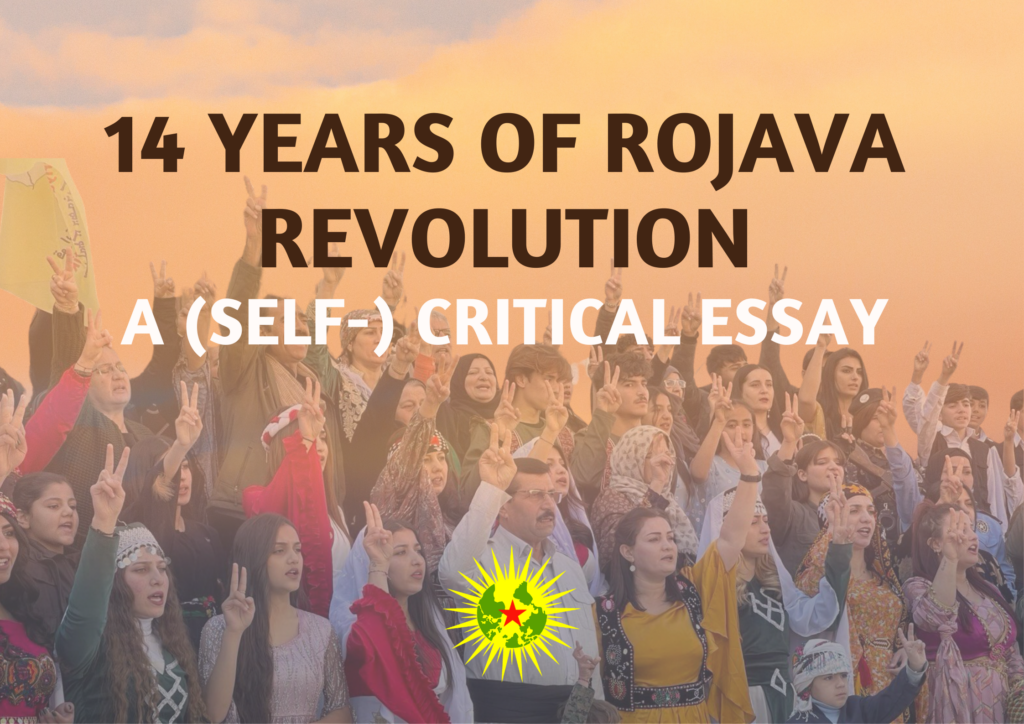
33 years of preparation
When Rêber Apo (Abdullah Öcalan) crossed the border between Riha (Northern Kurdistan/Turkey) and Kobanê (Western Kurdistan/Syria) in 1979, the Kurdish freedom movement began to spread across Syria, from Dêrik to Damascus. Society, which had suffered years of repression and violence under the Ba’ath regime, began to awaken and organise itself. From 1979 to 2012 – a total of 33 years – the people of Rojava organised themselves under the most cruel conditions of the regime’s occupation. Clandestine meetings, underground organisations, uprisings, joining the ranks of the guerrillas, and organising at universities were all building blocks that fostered an enormous spirit of resistance within Rojava’s Kurdish society.
The rise of the Arab Spring
When the rise of the Arab Spring in 2011 created a power vacuum in Syria, the Kurdish freedom movement and society seized the opportunity for revolution. With neither money nor weapons to hand, the population stood guard with sticks and pitchforks outside the newly liberated towns. With great creativity, motivation and perseverance, the revolution spread. Communes and councils were established, and the YPJ and YPG defence units were formed. Women took the lead in all political and social spheres. Despite constant attacks by the Islamic State, the predecessor of HTS Al-Nusra, the Turkish state and their imperialist allies, the revolution stabilised.
Between Attack and Resistance
However, it was clear from the outset that the capitalist world system would not accept this oasis of socialism. Consequently, attacks were launched on all fronts – military, political and psychological. Nevertheless, society gained confidence. This was further strengthened by the liberation of the predominantly Arab towns of Minbij, Raqqa and Tebqa, extending as far as Deir ez-Zor, and the defeat of ISIS. For internationalists, too, Rojava became a beacon of hope. Kobanê, dubbed the ‘second Stalingrad’, drew courageous people from all over the world – not only for military defence, but above all to experience a revolutionary way of life, the philosophy of Rêber Apo, and the values of women’s liberation, grassroots democracy and ecology. These opportunities, built up through great effort and the blood of many martyrs, became the foundation for the democratic organisation of society, as well as for the participation of internationalists. Yet, following a series of successes, a certain complacency crept in. Communes, which were initially used with the greatest passion for self-organisation, developed over the years into centres for meeting the material needs of daily life. Actually the communes should have built the heart of the self-governance of the society, but the technical approach weakened the initiative of the society and gave too much political power to the DAANES (Democratic Autonomous Administration of North and East Syria). At first, a certain degree of pragmatic administration was necessary in order to make quick decisions in the power vacuum and drive the revolution forward; however, centralist influences also crept into the DAANES. Military defences were strengthened, but the ideological and organisational defence of society was not sufficiently guaranteed. It was precisely following the losses in Afrin, Serekaniye and Gire Spi that a new phase began, bringing with it fresh difficulties. These losses were wounds that remain open to this day. Today, society still wonders what it might have been like had they not abandoned the towns, even if the sacrifices had been greater. Might HTS then perhaps not have had the courage and conviction this year to force the SDF into a position of retreat? This question is difficult to answer. Society is bound by its values and people are prepared to give everything for their country. But after years of war and enormous sacrifices, society is in the same time demanding peace.
Is the revolution even still continuing?
It is 19 July once again. We look back on 14 years of revolution, full of successes and failures, full of tears of joy and tears of pain. In the internationally orchestrated war of aggression waged by the HTS and its imperialist allies, major concessions have been made. It has reached the point where outside forces are asking: ‘Is the revolution in Rojava even continuing at all?’ We see with our own eyes just how perfidious it is when achievements such as the YPJ or the Kurdish language are called into question. Yet despite this, we answer the question of whether the revolution continues with a resounding ‘Yes’. Why? Because the Rojava Revolution is, first and foremost, a social revolution. However much geopolitical circumstances and military front lines may shift, we can feel the revolutionary spirit of society. Society is frustrated by the situation, yet more determined than ever to seize the opportunities of the moment, rather than merely focusing on the losses. It is prepared, once again, to give everything to defend its values. A young girl, whose family was forced to flee Afrin, is on her way back to her homeland. This is a historic moment for which people have fought with every means at their disposal since the occupation of Afrin in 2018. This girl will see her village, her home and her ancestors’ olive trees for the very first time. Yet she is thoughtful. When asked: ‘Aren’t you looking forward to going to Afrin?’ she replies: ‘But there aren’t any Hevals (friends of the Kurdish Freedom Movement) there.’ A Kurdish father tells us of his frustration with the Arab fighters who have withdrawn from the SDF and “let the Kurds down”. It is an emotion that is understandable after years of oppression and dispossession by the Ba’ath regime and the countless attacks by Arab-Islamist forces on the Kurds. But still it is obvious, that these emotions are dividing the society along ethnic lines and promoting nationalism. Yet when the same father spoke at a commemoration for a Kurdish and an Arab martyr, he pledged his commitment to the unity of the peoples until the very end, in accordance with Rêber Apo’s philosophy. For us, recognising these contradictions and the struggle that arises from them means that the revolution continues – there is no question of it.
Yes to a democratic Syria, no to jihadism and assimilation
There has been widespread criticism, with people asking how such an outcome could have come about. A self-critical analysis suggests that the structures put in place were not sufficiently democratic, that there was too much reliance on the tactical allience with the US, and that the organization remained confined to the borders of the DAANES rather than spreading sufficiently throughout Syria to form a stronger unity with democratic, allied forces. All these are factors – that are products both of the harsh external conditions and organizational shortcomings – have influenced the war and cost Rojava the political weight needed to assert its own interests more clearly in the negotiations. Yet it should not be forgotten that mistakes, however costly they may be, always provide a basis for transformation. More urgently than ever, society and the Kurdish Freedom Movement recognize the need to restructure themselves and to focus on democratic communes that organize from the grassroots up and bring the whole of society on board.
For society, it is clear: “We do not want to go back to the days of the Ba’ath regime; we want to defend our achievements.” It will take time for this fighting spirit to develop further. “Yes, we want a democratic Syria; yes, we want to transform the HTS regime from the ground up; but no, we do not want to be assimilated; no, we do not want to use our political and military strength for a jihadist system.” The integration that Rêber Apo proposes for Syria means the state plus democracy. The state must accept society’s self-organization and guarantee political and cultural recognition. Rather than simply rejecting the state outright, society must work and fight for its democratization. We are still far away from this dialectic. We cannot yet speak of democratic integration in Syria. We currently find ourselves in a phase in which the state is attempting to swallow up and assimilate democratic society. This calls for a strong political struggle.
International revolution means international responsibility
To win this political and diplomatic struggle, the strength of all international forces is required. Rather than merely observing critically and questioning, we must see ourselves as a vital part of this revolutionary process, and must thus find our own role in defending this revolution. The more pressure is exerted, the more society here is strengthened. The non-recognition of the YPJ is not a decision that lies in the hands of the HTS, but is above all a consequence of the policies of European states, for whom the YPJ is a thorn in the side as they pursue their patriarchal interests. The HTS was, first and foremost, normalised and legitimised by the US and the hegemonic powers of the EU. The move to insist on the dissolution of the YPJ is not merely a provocation by the HTS against Kurdish women, but a comprehensive political attack on the very heart of the women’s revolution – an attack not only by the HTS, but by all those political forces for whom women’s liberation poses an obstacle in pursuing their interests. All those who have an interest in a democratic, ecological and peaceful future for the Middle East – a future in which women can take their rightful place in all areas of life – must take a clear stand against this policy.
This stance is also reflected in seeing ourselves as part of this revolution and acting accordingly: if we see ourselves as revolutionary agents, we must recognise our own responsibility in each of our struggles. For, as revolutionary processes around the world are far more closely interconnected than might appear at first glance, the situation of the revolution in Northern and Eastern Syria will continue to influence the conditions of our struggle as revolutionaries worldwide. Fourteen years after the revolution was proclaimed in Rojava, the following is truer than ever: For us, the presence of the state will never be an obstacle for pursuing social revolution. To the contrary, 14 years of Rojava and the legacy of Şehîd Ziyad Heleb, Şehîd Denîz Çiya and Şehîd Koçerîn Lawîn, who resisted until their very last breath, continue to show that the unshakeable belief in society’s ability to struggle and self-organize remains a guarantee for building democratic autonomy all across the globe.