February 1, 2026 QAMIŞLO
The first day of the new agreements between our forces and HTS with Al-Jolani. Agreements that are necessary after this brutal and disgusting war. Nevertheless, we are all filled with anger. Southern Syria is in the hands of Israel. In the north, Turkey will leave Syria. The people of Sheikh Maqsoud, Efrîn, and Serê Kaniyê should be able to return to their regions. There will be joint military units. The Kurdish language should be institutionalized. The war should end. Ceasefire. Kobanê. What will happen to Kobanê, which is in a humanitarian crisis due to its siege by jihadist forces? What will happen to women in society? What will happen to the different peoples living throughout Syria? Integration. No assimilation. No statehood, but rather the establishment of communes. Now we will see how much we have learned from the revolution. How can we sit at the same table with the enemy? Rêbertî is our example. For 27 years now, he has been in the hands of the enemy on the prison island of Imralî, and yet he influences the enemy, changes them. These new agreements also followed the intervention of Rêber Apo. It will be increasingly difficult to fight for peace and maintain it. However, the war and the killing must come to an end.
During these weeks of war, the worst crimes against society have been committed. At the same time, the ideology of women’s liberation has been deliberately attacked. As a sign of this, the statue of Şehîd Rojbîn Arab was toppled and destroyed. Dirty, jihadist men attacked her. As they would like to do to every woman. To nip freedom in the bud. But after all this time, I think even more about our Arab friends. They are showing enormous courage and determination. They are part of the future of the democratic nation. The conflict between Arabs and Kurds is something that has been created, a method of targeted attack. These times require a lot of effort, patience, and willingness from each other. We must think more collectively so that we are not overwhelmed by anger, grief, and feelings of injustice. All those who are on the streets day and night, lying in trenches or tunnels, are there to preserve humanity. I am moved by this. We are at the heart of the revolution, and if we close our eyes for too long, we will see everything just fly past us. Being part of it today means defending our line today. It means seeing all our friends as role models. It means following Rêber Apo. It means believing and hoping. But it all starts with a decision! The decision for life, in society and community, in peace. No matter how difficult and rocky this path may be, we will take it on. With every step, we and the democratic spirit will grow. We respond to all the attacks of the enemy with a smile. Because no one can take away our love and solidarity. Being part of this special life, this historic moment, this revolution is much more and much deeper than being bound solely by physical boundaries. We choose success and beauty!
January 29, 2025 DÊRIK, CIZÎRE KANTON
Today we visited an Arab family—we’ve known them for quite some time and have watched their children grow up. They have a small garden and sometimes dogs, sheep, and chickens. It snowed in Rojava over the New Year—the first time in six years. Many of them had never seen snow before, so they all ran outside excitedly. The swirling snowflakes excite the people; the first snowball fights begin; everything is covered in a white, clean color. The air becomes moist and refreshing. The family’s children also run outside. The 15-year-old daughter, with a flower in her hand, walks eagerly into the garden, holding her phone in the other hand. She tries to find a place with a beautiful background to take a picture of herself with the flower and the snow. When she hears our voices, she pauses, looks around, and spots us on a nearby roof. She laughs sheepishly and disappears, but she doesn’t leave her family’s place.
Days later, the younger sons are on the flat roof to push down the heavy snow. They don’t have the right tools or clothing. Instead, they are wearing flip-flops, without jackets or gloves. After very laborious attempts, the mother also comes onto the roof, experienced in all the work that needs to be done. The daughters, the younger sons, and the mother are always outside working: whether it’s hanging up the family’s laundry, cooking food over the fire or preparing it for storage, feeding the animals and tending to the plants, or cleaning and repairing various items. An independent and skilled family, like so many here. Other people are rarely seen, visitors do not come.
On this day, when we go to this family with a young man who speaks Kurdish and Arabic, we meet the newborn – a boy who has taken his brother’s name. We chat, the father talks, the daughters prepare food and çay, the mother and grandmother take care of the baby, the sons sit quietly with us in the circle. We talk to one of their daughters on the phone. She herself is still young, goes to school, and likes math class the most. She understands a few words of English. We plan to go into town with her so she can show us her favorite place and introduce it to us. But she doesn’t usually go out; she has to ask permission. She can’t come and go as she pleases. The family doesn’t leave their house unless there is a major event. A family that has been displaced and attacked. A family that has been forced back into their own home and cannot find a recognized place in society—especially in these times. Their most recent roots are in Deir ez-Zor, a city in the south, where the northern part of the city across the Tigris River belonged to the autonomous self-administration, while the southern part was controlled by jihadist militias. The population is Arab.
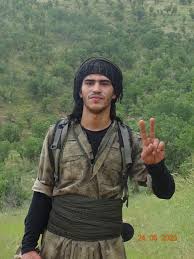
The son of our family joined the People’s Defense Forces (YPG) in his early teens and then fought alongside Kurdish and other Arab fighters for the liberation of Raqqa against ISIS. Because of his revolutionary decision to become part of this struggle to defend the land of the people, the family clan turned against them. They were excluded, persecuted, threatened, and even subjected to attempted murder. Ultimately, they had to flee from their own family to protect themselves and their son. They had to leave their homeland, the place of their history and memories, the place of their culture and roots. They then settled in a city where there are no Arabs, but mainly Kurds, Assyrians, and Alevis. However, they have no contact with them. A few months ago, their son fell as a martyr in the free mountains of Kurdistan. His martyrdom had a great impact on the movement, and his funeral was a large one. The city was empty, everyone gathered at the martyrs’ cemetery. The family is in a difficult situation, but after all the speeches, the father composes himself and steps forward. He shares his pain and grief with the people. But even more, he shares his pride and hope. His son, Şehîd Masîro, had become a great fighter, a revolutionary, and a defender of ethical and democratic values. In doing so, he took on an important pioneering role. Later, he says that he has many children, but his son is the first to have taken this courageous step. In order to avenge the martyrdom of his son and continue his brave struggle with great visions, he promises all his children to the movement. They are to follow in their brother’s footsteps and thus commit themselves to a life of justice for the peoples. Heval Masîro, but also the whole family, show a great willingness to make sacrifices. Defending this revolution requires many sacrifices, but these are sacred to us. For they symbolize the union with the necessity of a revolution of humanity. All these people can become part of it.
The story of this family reminds me of a friend, Heval Arîn, who herself comes from Deir ez-Zor and joined the movement as a young mother. She has experienced a great deal of pain and suffering in her life. She had to endure extreme torture in the Assad regime’s prison for a period of time. Not because she had committed a crime, but because she is a woman who moved around outside on her own. The Syrian regime, both the previous one and the transitional dictatorship under Al-Jolani, speak in the name of Islam, but they present themselves as the most misogynistic and misanthropic rulers. Our friend recognized this, even though she was manipulated and isolated in the clutches of family life. She gave birth to a baby with a violent man, which made the oppression against her even worse. It was not a marriage or birth of her own choosing. Young women are sold and used by their husbands. But she has realized that as a young woman, she has other rights, a different perspective on life, and thus the opportunity to join a movement that fights for women’s freedom. Her joining the movement has triggered a similar reaction to that in the other family. But her family has turned against her, is now looking for her, and wants to kill her. She is not deterred by this, but follows a strong will. This will is evident in her attitude. In a short time, she learns Kurdish and studies the history of the party. She is touched by all her friends who followed the same path and ultimately joined the journey of the martyrs for a shared future in freedom. When people become aware of their oppression, they can overcome their numbness. Instead, it becomes a source of motivation and revenge. The greatest revenge against the attacks of the enemy, which are ideological but also very physical, is the solidarity of women of all nations. On the simple but profound and aesthetic foundation of life. She will express it in her gait, in her way of speaking and thinking, in her laughter, her love, and her sociability.
January 30, 2026 HESEKÊ
We often talk about the contradictions we encounter when we approach the movement. We Europeans in particular often have problems with very fundamental issues. Why is Rêber Apo referred to as the leader? How could a man have established and proclaimed the ideology of women’s liberation? How can a man be a pioneer for women? Why do we distinguish Rêber Apo from other well-known philosophers and thinkers? Heval Arîn also had such thoughts and doubts at the beginning. But the essential thing is that she carries trust and a deep love within her. Contradictions did not remain rigidly fixed within her, with no chance of change. Instead, they were the beginning of a deeper search. She learned about the history of the party and got to know her friends. She is impressed by the line of self-sacrifice and the enormous willingness that everyone brings with them.
Self-sacrifice begins with the first promise, then flows through every moment and ends with complete devotion to defending our lives. We, who strive for change in this life, for freedom. For all of us, freedom means something different, has a different nuance. But especially as a woman, freedom means being able to follow the love of creation unhindered and with determination. Rêbertî, this is, Abdullah Öcalan, is on this path, is our embodiment of freedom and self-sacrifice. All those who can recognize this find relief and peace within themselves. Creating existence out of invisibility. Awaken choirs from silence. Evoke rays from darkness. Find vastness on the horizon from confinement. Create diverse color changes from grayness. Communalism and sociability develop from loneliness. Stimulate creativity from heaviness and dullness. Plant wild gardens from cages. Individualism ends in socialism. To make a promise to this movement means at the same time to make a promise to achieve all these elements.
In the party’s history, our friend finds the story of Şehîd Rojbîn Arab. An Arab friend from Beirut who grew up in Turkey under strong assimilation and joined the movement in 1993. She, too, was greatly impressed by the pioneer Rêber Apo. Because Rêber Apo connects people and their souls. No matter what their origin, nation, history, or religion. Sehîd Rojbîn found her place and was thus able to free herself from the clutches of her society, which had determined a dead end for her. She understood that the influence her family and tribe had on her had been shaped and corrupted by the system. She grappled with the question, “How can I be a good Arab woman?” But Rêber Apo pointed her to the essential: “How can I be a good human being?”
I sit here thinking about how we can be good people. Despite all the colors and diversity that shape us. The position of women in Arab society is extremely restricted and oppressed. Much happens in the background, hidden and unbeknownst. I am moved by all the courageous women who have taken the first steps toward liberation. The friends who fight alongside us to the end and whose Martyrdom becomes a meaningful moment. There we find the good people. The people who do not simply accept, but actively seize every moment to fight against the system of oppression and exploitation. A struggle for the development of deep love for society and everything that is part of it. A struggle for the freedom of women and peoples. A struggle for the freedom of Rêbertî.
Rêber Apo also says: “If you say ‘war or war,’ you know how to fight. If you say ‘success or success,’ you know how to achieve success. If you say ‘become beautiful or become beautiful,’ you know how to achieve this. There will never be another consequence to this decision.” It is in our hands.