19 January 2026
It has now been exactly one year since another young internationalist woman and I were there, in the resistance at the Tishreen Dam. After the resistance of society successfully pushed back the jihadist SNA militia and a ceasefire was negotiated, this year in Rojava was marked by struggle, hope, reflection and action. A year has passed and, as almost every year, war started once again in winter. But this time, the attacks were on an enormous scale. Since the jihadist militias took over the government in Syria, their scope of action has increased immensely. This is mainly because they have the backing of all the states from America to Europe. In this sense, when the whole of Northern and Eastern Syria was brutally attacked again this year, after many successful actions in Tishreen, a strategic retreat took place and the SDF and YPJ moved from Tishreen to Kobanê. Strategically, I understand this, but emotionally I am angry and upset. It feels like a great injustice that Tishreen is now in the hands of the jihadists. But I also know that the resistance of Tishreen was not in vain. It has gone down in the revolutionary history of the peoples. It created values and legends that are indestructible. Nevertheless, I have this feeling inside me. I have to write. I have to make known what we went through in Tishreen. I have to tell the stories of all those brave women, men and young people we got to know during our three days at the dam. And I have to transform my pain over the loss into revenge and hope for a just future.
Yesterday, we visited the wife of Şehîd Mihyedîn, who gave his life in the Tishreen resistance a year ago. She said thoughtfully, ‘When I saw that Tishreen had fallen into the hands of the jihadists, it felt as if Mihyedîn had fallen Şehîd once again.’ She was not sad, but full of anger and conviction. Her head was held high. What does death mean to her? In revolutionary Kurdish culture, death is not the end. There is no strict separation that says life is good and death is bad. Just one day of living with the right values and principles and resisting can be more valuable than years of perseverance in the wheel of the system. Before Mihyedîn went to Tishreen, he said to his wife: ‘I don’t know if I’ll come back, I’m ready for anything,’ and she knew it too. Their farewell was a farewell forever. They knew it and they didn’t know it at the same time. But they did not mourn. They were aware that whatever happened, it would be worth it.
19 January 2025
So we set off. We too knew that we might not come back. It was one of the most important moments of our lives. We left early in the morning in a long convoy of cars, and when we reached the area around Tishreen, the sun was just setting over the Euphrates, bathing the sky in beautiful shades of red and orange. A comrade in our car joked, ‘Look at the beautiful sun, we may be seeing it for the last time.’ Kurdish humor is incredible; even in the most heavy situations, the Kurds have learned to deal with difficulties in a light-hearted way. When I remember Tishreen, what comes to mind is a complete determination to succeed. The bombings began even on the way there. At some point, our cars could no longer continue because the road was heavily bombed and destroyed. A reason to turn back? Not at all. We crossed the surrounding desert with difficulty, but when we reached the road again, we were very excited.
As soon as we reached the dam, we were greeted by people dancing around the fire, singing and shouting slogans. All around us we saw bombed and destroyed cars and collapsed houses. It was like a change of worlds. The heaviness we had felt so intensely during the recent war period vanished. We joined in the dancing and became one with the rhythm of the music and the people. We went to bed late, in a room with 30 women, but no more than 10 mattresses and a few blankets. In general, there wasn’t much, and it was quite chaotic. The action began spontaneously due to the acute threat from the SNA, which wanted to capture the dam in order to conquer the whole of North-Eastern Syria. Perhaps last year, this sentence seemed like propaganda to some people. But today we see the reality of these jihadists. This makes Tishreen’s success even more significant.
20 January 2025
Morning
The next day, we got up early and started our work. We filmed the surroundings, a beautiful hilly landscape, the mighty Euphrates and completely destroyed houses, ghost towns that had long been abandoned due to Turkey’s constant air strikes and drone attacks. We also followed the sound of Turkish drones, ‘sssSSSsssSSSsssSSS’. They circled constantly over the area, but we didn’t care. We wanted to do our work. We interviewed the people. Their attitude was clear: ‘We are bigger than death. Whatever happens, we are not afraid and we will not leave the dam.’ We were impressed by their morale and couldn’t stop listening to them. We forgot to eat until some mothers saw us and said: ‘My daughters, you are working without a break. We won’t let you go until you’ve eaten something.’ There wasn’t much anyway. We sat on the floor and shared bread, tinned hummus and some packaged cheese with each other. But we couldn’t sit still. After we had eaten something, we looked each other in the eyes and stood up, ready to continue our work. The mothers smiled at us and let us go. We went back up to the dam and joined in the ‘Govend’, the traditional Kurdish dance that has become a symbol of resistance in the history of the Kurdish struggle.
Afternoon
In the afternoon, we gathered to go to the area in the other side of the river to assess the humanitarian situation on the ground and provide support where needed. The frontline, was only a few kilometres away. Everything around us was destroyed. We stayed on the asphalt because there could be mines in the surrounding area. The Turkish state bombed the area to intimidate us. We responded with slogans: ‘Berxwedan Jiyan e’ – ‘Resistance is life’. Suddenly, a friend appeared in front of us. Heval Nujîn! She was covered in dust, and there was a heaviness in her gaze, but it disappeared when she smiled at us. We saw each other, ran towards each other and hugged. We were so happy to see each other. We said, ‘Heval Nujîn, we want to come with you.’ With sparkling eyes, she simply said, ‘Yes, you can propose yourself!’ But even though it was tempting to simply follow her and join the resistance in the tunnels, we knew we had other tasks to do. Our weapon was our camera, and our duty was to bring to light what had happened here. So we returned and continued our work with even greater morale.
Evening
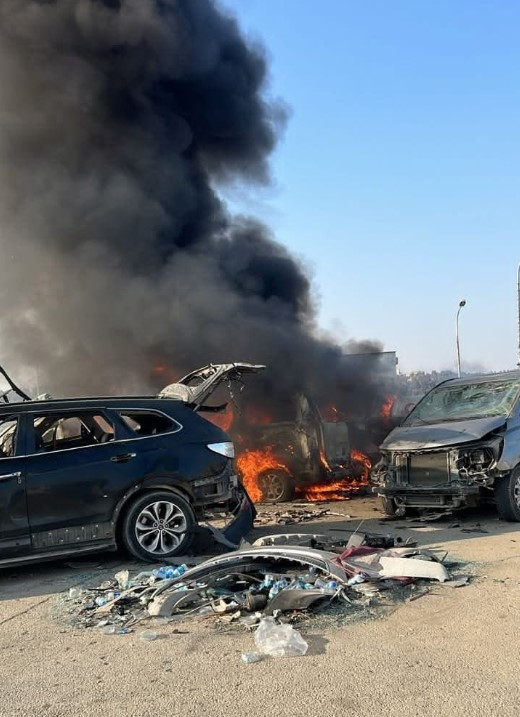
In the evening, there was another violent explosion right next to the dam. What should have frightened us motivated us more and more to resist, every time the earth shook.
When we returned to our room in the evening, which we shared with mothers and young women, we saw that all the windows had been broken by the pressure of the bombing. But that didn’t bother us; we huddled together and shared the few blankets we had. During the night, I woke up several times because the mother next to me threw her blanket over me. I pushed it away and said, ‘No, I’m really not cold.’ But as soon as I fell asleep, the mother took the opportunity to give me her blanket again.
21 January 2025
Morning
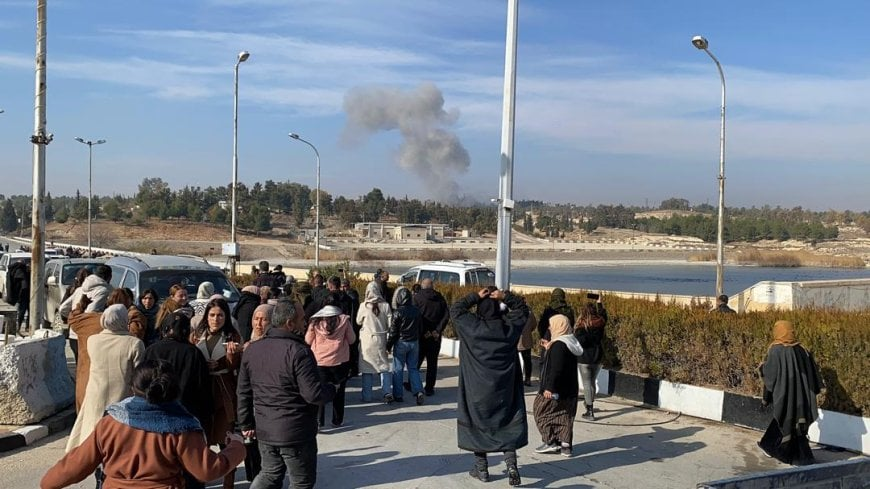
This day would be a hard day. In the morning, we were still singing ‘Bella Ciao’ with the people. We danced in the Govend, energetic and strongly. When noon came, we spontaneously decided to make a video of the dance so that the whole world could see this spirit of resistance. We left the Govend to prepare our camera, and suddenly there was a BAM! This time it was different. The bomb hit right in the middle of the Govend. Around us, people were screaming, there was blood everywhere and people were injured. Fortunately, when we arrived here in Rojava, we had learned how to use tourniquets. We decided to take our tourniquets and ran to the injured. The mother screamed and looked desperately at her bleeding leg. I took the tourniquet. I had never done this before. I shouted, ‘Can someone help me? I’ve never used a tourniquet before.’ But when I looked around, I saw only people who were themselves lying on the ground or already helping others. I realised that it was me who had to take full responsibility for this woman’s life. So I got to work and did my best. After a short time, we brought all the injured to a safe building. As we later learned, there were 72 injured. We helped where we could. I cursed myself for not having learned more about medicine when a young doctor asked me to bring him a specific cannula that I couldn’t distinguish from the others.
I don’t know when
After a while, the situation calmed down. But word quickly spread about ‘two martyrs’. Who are they? Who are they? They were Hezna, the courageous woman from the civil defence units HPC-Jin and Mihyedîn, the loyal father of a YPJ martyr and responsible for PYD work in his village. Grief and anger were great, but there was no time for stagnation. We went from injured person to injured person, helping where we could, until it got late. The few doctors who were there did not stand still for a second.
A few friends were seriously injured. The doctors decided that they should be taken to the hospital in Tebqa for treatment. I knew Leyla well, so I accompanied her to the ambulance. She was feeling dizzy, but she still tried to smile at me. When we had brought all the seriously injured people into the car, the earth shook again with a terrible loud bang. The Turkish state was firing right next to the ambulances. What to do? The flight reflex says, ‘Run into the house and save yourself.’ But the conscience says, ‘What will happen to our injured friends?’ The Turkish state had bombed ambulances several times before, so we were prepared for anything. So we decided: the injured had to get out again. There weren’t many of us. A young doctor and I set off. With great effort, we dragged the injured into the house. I grabbed the shoulder of a stocky young man whose shinbone was shattered. I wanted to lift him, but I couldn’t. He screamed. I didn’t have enough strength to carry him, and I cursed myself once again, this time for not doing more strength training. But there was no time even for cursing. A revolutionary must find a solution in the most hopeless situations, I told myself. So, I changed position and carried on. A friend came and together we managed it.
In all these moments, the urge to flee haunted me. Run, quickly, save yourself. But no, I couldn’t listen to that. The young doctor motivated me with her clarity. It was a struggle, I won’t deny it, but the conscience won out.
Evening
Are we tired? ‘No, the enemy is tired!’ we convinced ourselves. We were still with the injured. A young woman had her entire leg shattered. We sat with her, brought her tea and biscuits. She was so happy to see us and laughed with us. Another mother had only a bomb splinter in her finger. Just the day before, we had photographed her holding her two fingers in the air as a ‘symbol of success’. I said to her with a laugh, ‘Mother, now you have a splinter in your index finger. Now you can’t make the “success symbol” anymore.’ She laughed too and replied, ‘During the bombing, my fingers were in the air again, so they could be hit by the splinters. Nevertheless, we will succeed.’
At some point, we found a quiet moment. We made ourselves some tea with lots of sugar and sat down. Breathe in, breathe out. What had we not experienced?
22 January 2025
We went to bed late and woke up early. When we went outside, the rising sun was blood red and hundreds of birds were circling above the Euphrates. The water in the dam bubbled steadily, on and on, as if nothing had happened yesterday. Slowly, people gathered again at the top of the dam. No one said it, but everyone was thinking the same thing. It happened yesterday, and it could happen again at any moment today. But then our friends started playing music. Slowly, the crowd gathered. Of course, there weren’t as many people as yesterday, because 72 people had been injured. Heval Hezna, who was always at the front of the Govend, was also missing. Mihyedîn’s sincere gaze, the smile on his face when he watched us dance, was missing. As we lined up for the Govend, a very special feeling came over us. Yes, we were really ready. We were ready to give our lives, all of us. Otherwise, none of us would have dared to dance. And experiencing this feeling together made us so strong. We danced and danced, and around us we heard the drones and the bombs. But what vanished yesterday with the dust of the explosion was our fear.
Midday
We set off for the other side of the river a second time. The way we took yesterday had been bombed so we looked for another way. Suddenly, gun shots rang out. ‘The SNA has arrived!’ flashed through my mind. I looked around and saw a remote-controlled drone approaching, and our friends from the SDF trying to shoot it down. Again and again, and suddenly: BAM! The drone dropped its bomb, and it hit just a few metres away. What to do? Run, but not to safety, rather towards the injured. As I run, I unpack my tourniquet and stop in front of a man. I calmly sit down and begin to apply the tourniquet. It’s like a dream; my hands move on their own. Only when I was finished and a few men came to help carry the man to the car did the man’s eyes suddenly open. He just said in amazement, ‘My leg is gone.’… and only then did I realise that his leg was gone. We lifted him into the car. Next to him lay Mehmet Şefîq. The same young doctor bandaged his chest. She looked at the wound and I saw in her eyes that it was too late. I wanted to approach to understand the situation but the car was already driving away.
And us? We continued on our way. A friend who limped due to previous war injuries ran ahead of everyone and shouted slogans. Her slogans motivated us. I looked back once more. Our paths and those of the SDF fighters diverged. The fighters returned to the tunnels, and we returned to the dam. Our paths diverged physically, but our hearts had long been united.
Sudden departure
We didn’t want to leave. Everything in us screamed that we should stay. But we knew that a lot of work was waiting for us. All the voices, all the experiences had to be shared. Before we left, we sat together one last time over instant coffee. A middle-aged woman who had panicked during the first explosion proudly told us about her experience during the second explosion. She reported in a loud voice: ‘There was a bang, and then I ran. I took my scarf and wrapped it around the leg of an injured person.’ We were amazed. In just two days, she had overcome her panic and become an active helper. That was the spirit in Tishreen. Every hour, no, every minute, changed you. Strengthened you.
Again 19.01.2026
Especially in the last few days, I have been thinking a lot about Tishreen. I think about Şehîd Mihyedîn, Ş. Xxxx, and all the other that gave their lives. Maybe from the outside it is hard to understand but living through it makes you fell why this resistence was so important. The victory of the people’s resistance was achieved with the slogan “We are greater than death” was the main source of strength for the people of the world that see. The people made their decision to resist, whatever it would cost. We, as internationalists, as young women and youth must also make a decision on this phase. We will give everything, because giving only a little bit is on longer enough. It is time for change. I wish you all had the opportunity to be here and to experience all this from here. To feel the power of socierty around you, because feelings of hopelessness, powerlessness, fear or anger are transformed here, second by second, into revenge, into action, into organisation and into spirit of self-sacrifice. Why the people here has such strength? It is not they are not afraid at all or perfectly organised they have such a strength because they know that it is all or nothing. There are no save shores to where they can flee. So they overcome their fear and strengthen their believe in their goal: freedom. We, too, should burn the boats that liberalism provides us with. The backdoor we flee to when we convince ourselves that this war is too far away after all. There is no time for hopelessness. There is so much to do. There is so much revenge to take for all the martyrs. As a friend put it, with the body of Şehîd Denîz Çiya, not only was a revolutionary woman thrown down, but also the conscience of humanity. It is up to us to pick up this conscience. It is up to us to give it wings and carry its spirit throughout the world. I know for myself that I am not yet giving my all. I must try harder. We all must. Rêber Apo’s words encourage me when he says, ‘Human beings have the potential for limitless development.’ It is possible. We can and must all go beyond ourselves and play our part in this historic time. And we believe until the very end that we will succeed.