Today our comrade Heval Azad, Thomas Spies, would have become 30 years. On this occasion we share this Interview with Welat Cûdî, who stayed together with Heval Azad in the mountains of Kurdistan.
Can you briefly introduce yourself and tell us how you got to know Heval Azad?
My name is Welat Cûdî. First of all, in the person of Heval Azad, I want to commemorate all the martyrs of the revolution. We have so many martyrs, for this struggle, for this cause. All for a free life, a shared life. Not everyone has fought such a struggle. Not everyone has carried out such a profound resistance, with this cause, on the path and the ideology that Serokatî showed us.
Many of our friends sacrificed their lives for this cause, so that we all, everywhere, can live a free life, a common life, and live together in peace and harmony.
So I met Heval Azad in a cave. His group had just arrived and that is where we met each other. He was very warm-hearted. His participation and exchange in life were very good. His discussions were good. We had a beautiful kind of friendship, in which we quickly warmed up, and in this way we got to know each other.
We talked, I wanted to talk with him and asked, “What will you do? What are you doing?” He answered, “I am going to the front line. My intention is to go to the very front line.” The friends really fought with him to send him to other areas of work, but he said, “No, I have been here for so long, I must go to the very front line. I will go forward so that I can shoot bullets at the enemy there, which I can at the same time shoot at capitalism as a whole.”
He had these thoughts. Socialist thoughts. He was scientific. At that time one noticed that he had developed such an awareness. A scientific approach, not just any thoughts. More understanding. He had understood, knew what to do. That was noticeable in Heval Azad’s personality. He was very practical. He did things, he liked to build many things. Heval Azad had such an attitude. That is how we got to know each other, through our conversations.
How was it for you to meet a comrade from Germany in the mountains?
Really, when you get to know such a friend, an international friend who has come from such a far-away country and you see his desire for freedom… He really loved life. To meet such a person was a really great joy for us. A person who liked the ideas of Serokatî so much that he came from so far away to fight, that makes one proud. Really, seeing him, getting to know him, filled me with pride.
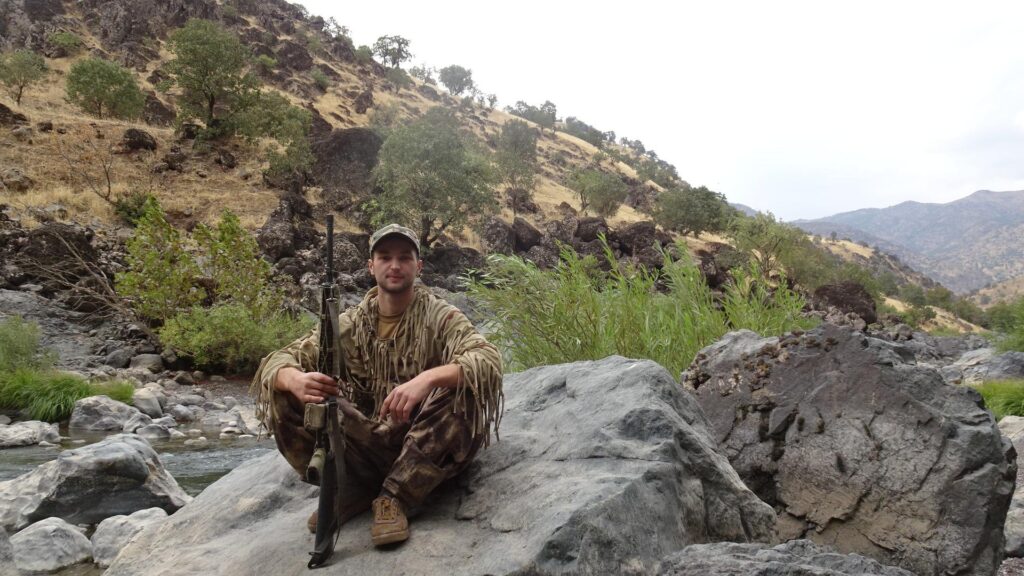
I said: He loved this struggle so much that he became a drop in it, and this drop could become an answer to the requirements of this revolution. Not for the revolution in Kurdistan. It is not a revolution only for the Kurds, this is an international revolution. I saw international friends, German friends, friends from other countries. To see Heval Azad was a great joy. It was such a feeling, a great love developed in me.
What was Şehîd Azad’s personality like? Especially as a German you got to know German society through Heval Azad’s personality. Were there particular character traits that stood out to you?
Personality traits that particularly stood out to me in Şehîd Azad were first his discipline and his attitude. He said, this task I will complete like this, and then it was clear that this work would run like that. He said, “I get up at this time, and work at this time,” and then it went that way. In his attitude there was this natural discipline. So one really loved his attitude and was influenced by it.
So, one has met German friends, and knows about German discipline. The friend had this discipline but also this great love, the love for a beautiful life. It was completely different. I said, he has a real understanding. What stood out to me the most was how well he could read. Believe me, I don’t know many who can read Kurdish as well as he could. He developed his Kurdish so far, his literary knowledge. One took him as an example. As his friend, at his side, one always took him as an example. Until today I take him as an example. He always set an example. His attitude is what stood out most.
So we got to know each other. It was difficult, we were together on the very front line. We lived together. In his conduct one always saw the desire, the desire for revenge. The feeling in his heart for the friends who had fallen at his side… that bound him even more to the cause. His attachment became stronger. One knew that he strengthened his attachment above all.
Sometimes, actually many times, we set off together for actions. One action we set off for was a sabotage action. We were really exhausted. By God, we marched for more than a week. We both had hardly any supplies. And what happened? Heval Azad said: “You eat.” I then said: “No, you eat.” We were so connected, we took care of each other. I saw in him that he always thinks of his friends. “This is my friend, he should eat.”
Sometimes he joked and said: “Heval Welat, we must be the first to fall, you will be the first to dig and it will be hard. Come on, eat something so you don’t get exhausted.” That is something we experienced together.
After that we went, carried out our action. In our action 16 soldiers were killed. Our action was successful. When we were on the way back, we were extremely exhausted. There were great efforts. What stood out to me most was what happened when we got into an ambush on the way back. The enemy surrounded us. When the enemy surrounded us, what did I see? Heval Azad said: “Heval Welat, wait, I will go first, nothing should happen to you. I will go forward.” I said: “Heval Azad, wait, nothing should happen to you, I will go in front of you.” He said: “No, I will go.” Such a discussion developed between us.
The enemy hit us very hard. They fired mortars, howitzers and grenade launchers at us. One of them exploded near my head. I bled. Heval Azad saw that and said: “Heval Welat, I will take you on my back and we will go. Your legs are full of blood.” I said: “No Heval Azad, let it be. If we walk like this together, the enemy will hit us immediately.” He said: “Heval Welat, you go in front and I will run behind you. I will follow you. If a bullet comes from behind, it should not hit you.”
In this time a strong connection arose between us. I saw that he felt the pain that I had suffered. He helped me a lot. Especially this time connected us and welded us together. I always said: “Wherever I go, I take Heval Azad with me.” We always wanted to go together. It was like this, sometimes the friends said: “We are going on an action.” I always said: “Let Heval Azad come with us.” Or when Heval Azad went, he said: “I am going with Heval Welat.” Such a love and connection developed between us.
How long were you together in the mountains?
One year we were together. We were together on the very front line and between us and the enemy, how should I say, there was not much distance. At the place where we were, one clearly felt the presence of the enemy. There were many difficulties. That was the front where we were together for one year.
Something that brought us together was the food. Mostly we could only eat rice. Morning, noon, evening rice. Sometimes there were potatoes and we ate potatoes morning, noon and evening. The potatoes that we ate together, when we ate them, that was not just a small thing but we said: “Hey, what are we eating today?” There was mutual love and that made the food better.
Did he sometimes mention German food? Did he miss his homeland?
Yes, he mentioned it. But how did he mention it? We were again at the same place together and had nothing to eat for a long time. Then he asked: “Heval Welat, what did your mother cook?” I answered that she cooked this or that dish. We were hungry.
He also mentioned: “My mother cooked very well. She made very tasty potatoes.” We were of course very hungry. When we talked about it, our stomachs growled. I joked and said to him: “Heval Azad, where our cultures are closest are potatoes.” He said: “Right, my mother made such delicious food with potatoes.” Then I told him: “I lived most of the time in a village and what we mainly ate there were potatoes. We mostly cooked and ate potatoes.”
How was the day for you when you learned that Heval Azad had fallen?
When my friend Azad died as a martyr, I was not with him. I was somewhere else, because I was wounded. Honestly, if not so many people had been there, I would probably have cried for hours. I was so angry. It stayed so deeply in my heart. How could this person, with whom we worked, lived and whose voice we listened to, become a martyr? I will never forget this voice. His smile, his smiling face, all of that was in front of me when he became a martyr. That hurt a lot.
This feeling, as if a part of your own body had been removed. That is how strongly I felt it. Believe me, it felt like a part of my body was missing. To see Heval Azad, to feel him like this, to be together like this and then he falls as Şehîd (martyr). It was very painful. Yes, he said: “I will fight in the war and one day fall,” and that is how he fell, but it hurts a person very much. When one talks about it, how should I say, one cannot, it was really very strange.
I have worked with many friends in practice, but the practice that I lived together with Heval Azad, our friendship, his life, his smile, his communication, as long as I live, when I see friends, I will be reminded of him. This feeling remained. It is very painful.
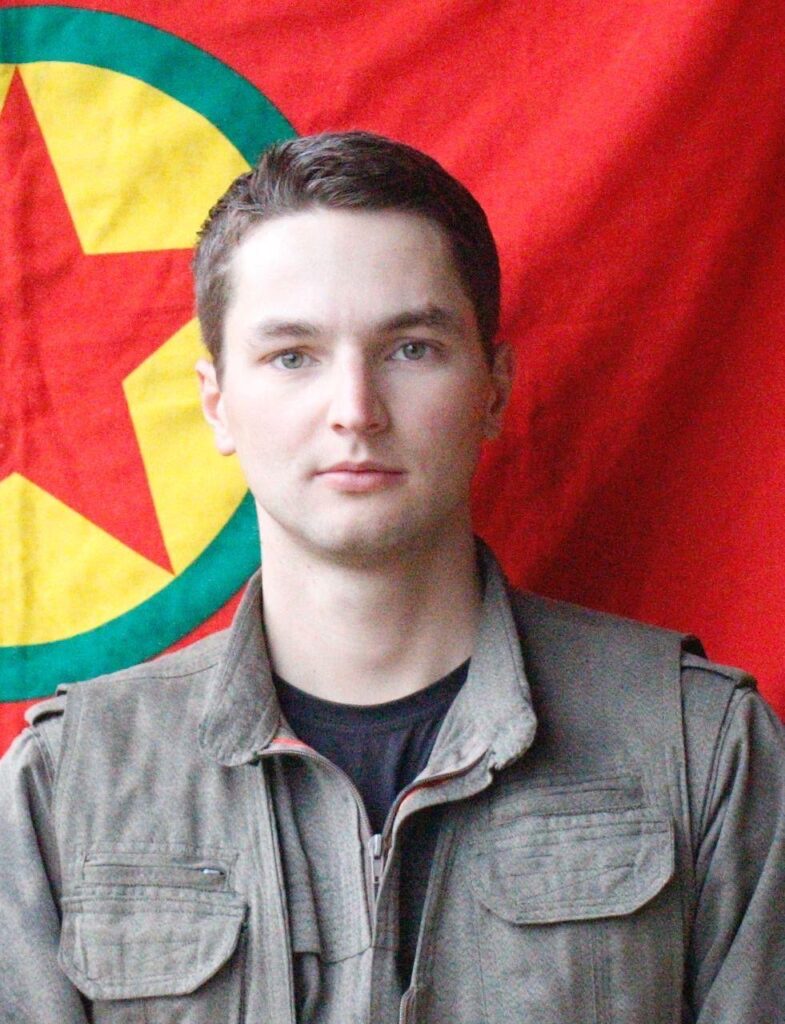
In what way is Heval Azad, his life and his path a role model for socialist youth, for youth who are searching?
All international friends, all revolutionaries, everywhere in the world, who fight, who make revolution, who fight for the revolution, politically, the youth — he was a role model for all friends. He was an ideological example, an example of attitude. The things he told me, I have not forgotten.
He said: “Maybe we could not fight everywhere, but I believe that I recognized that on the path of the revolution, on the path of real socialism, I can take the steps in the PKK.” He saw that in the PKK. I said: “I am a revolutionary. Yes, we fight for the revolution, but with words alone we cannot fight.” He said: “Right. You can fight, but if you do not develop power, no one will listen to you.”
He always said: “I must go and bring all the youth here, so that they see how the PKK is. What the reality of the PKK is. What the truth of life is. And what the real ideological struggle of socialism looks like.” He expressed a great love for that.
We wish all internationalists, wherever they fight, success and see their struggle as sacred. In the person of Heval Azad one finds an example of true friendship and life. How one fights in allowing oneself to search, one should remember Heval Azad like that. Read about him, there is a book about him. There you will see what a person can do, what one can recognize in oneself.
For example, if a person does not believe in themselves, one can just read a little and see what power a person has who believes in themselves. One can discover the right belief. Every international youth who can read Serokatî, and has read Serokatî, can understand what Heval Azad found in it and what so many martyrs of the revolution found in it. And especially international friends who fight for the cause, our friends for example who all go on the basis of the right thoughts, when you see their attitude, you see that they have never bowed. Forever: We will win or we will win. We say to all our friends: Either we will win or we will win.
Is there anything you would like to say at the end?
At the end there is nothing else except that regarding friendship, the friendship of Heval Azad, his attitude, his life, was always a role model for us and all friends. Of course, all friends with whom we marched, all who became martyrs, live in our hearts, but Heval Azad took a special place in our hearts. Imagine it like a soul, a vein, and when this vein is cut, the person finds a place where they belong.