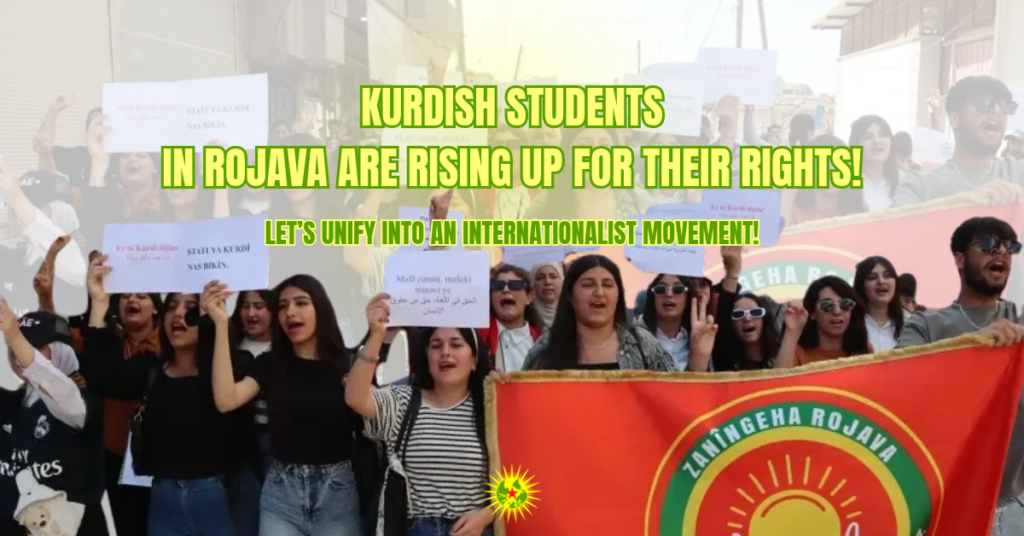
They are protesting for the recognition of their right to an education in their mother tongue, as well as against attacks on the autonomy of Kurdish universities. For 15 years, the Rojava education system has been self-organised by the DAANES (Democratic Autonomous Administration of North and East Syria). So why are the students’ rights being taken away now?
At the beginning of this year, an intense war took place in North-East Syria. The jihadist HTS army, backed by NATO and Turkey, attacked Rojava and North-East Syria. Their aim was to eliminate the people’s autonomy and dismantle the democratic values and women’s freedoms practiced in Rojava for 15 years. To prevent a massacre of the Kurdish population, an ceasefire agreement was signed with the HTS on 29 January. Although this paved the way for the possibility of some democratic change and legal recognition of the Kurds, not just in Rojava but across all Syria, the agreement has serious shortcomings.
Until now, the Rojava Revolution has been isolated from the rest of Syria and has always been targeted by hegemonic forces. Whilst the revolution was able to achieve significant gains both economically and in the development of a truly grassroots democratic system, due to continuous attacks it was not possible for society to fully realise its potential for self organisation. Furthermore, the reality of constant war meant that the revolution could not easily spread throughout wider Syria and the region as a whole. When the genocide in Gaza occurred, Rêber Apo recognised the danger of a similar attack being aimed at the Kurdish society and initiated the “Peace and Democratic Society” phase. This involves the democratic integration of the Kurds and their societal structures into the surrounding nation states. Rather than a relationship where the state views society as an enemy, a relationship develops of mutual cooperation and respect for democracy. In this way Reber Apo opened the door to a peaceful solution, where society can find the space to flourish and the possibility exists to transform the state.
This attempt to create peace and find political solutions prevented the ‘Gazafication’ of Rojava, but the Syrian Transitional Government is still not willing to accept democratic integration. After the hot phase of war ended in January, a period of political struggle began. A key part of this struggle was to persuade the state to recognise the Kurdish language rights. The jihadist Syrian Transitional Government wants to impose a uniform Arab-Muslim vision of Syria. It has not granted the right to education in the mother tongue or accepted the autonomy of the school system in Rojava. Even so, a notable achievement of this period is that the Kurdish language has been recognised as an official language of education in Syria for the first time, but lessons are restricted to a 3 hours per week and Arabic is still imposed as the dominant language on Kurdish students.
This is why the protests are continuing. Students in Rojava are not willing to give up the achievements of the last 15 years of the Rojava Revolution, which has been as much a women’s revolution as a cultural revolution, striking against the assimilation politics imposed on Kurds for hundreds of years. The students are determined to protect these achievements. The number of youth joining the protests are growing. Recently, the Syrian Transitional Government tried to take control of the Rojava University and merge it with the Fırat University. This would mean that the language and curriculum would change according to the regime, and the faculties that were organised based on democratic principles during the revolution would no longer be able to work autonomously. On 16 November, protesting students were attacked by internal security forces. The resistance continues!
Students in Rojava are calling for international solidarity! During the Rojava Revolution the youth became an leading force within society, and the education system was an example a democratic system co-created by students and teachers. The youth of Rojava will not now be silenced. The youth want peace, democracy, and cultural and language rights. Support these demands and spread the word at your local youth protests!
Proposals for action:
1. Send solidarity greetings from your demonstration to the youth of Rojava
2. Make signs and banners with slogans in solidarity with their resistance
3. Organize or join local events or online-calls about the student protests
As the Internationalist Commune we want to actively support your efforts and struggle all around the world. Any questions or proposals you have we want to hear them, this will be the century of the women’s revolution and the youth will show the way!
Our contact: [email protected] / Instagram: @internationalist.commune