January 11, 2026 CIZIRE CANTON
Six days of revolutionary defensive warfare. Two neighborhoods, surrounded by Islamist gangs, become targets after a charade of negotiations, and beneath the masks of the so-called soldiers of the new Syria, the true faces emerge, showing Slafist beards and Turkish flags on their clothing. Aleppo, the city already devastated and riddled with bombs and ammunition in 2013, where, through historic resistance, the population and their martyrs liberated the two Kurdish quarters of Sheikh Masud and Eshrefî. In triumph over the gangs and their repugnant ideology of killing, two tiny neighborhoods became a place of free will, hard-won dignity, and lived democracy. And simultaneously, a thorn in the side of all fascist, misogynistic, and capitalist forces in the region (and far beyond).
Aleppo became a target for a second time. Not as a tactical location, but as a strategic ideological nexus for the Apoist, patriotic, highly political, and grassroots-democratic population, organized down to the last fiber. For years, the people there have lived under siege. The hardships of sanctions (winters without heating oil, months of bread shortages) and abuses, such as the arrest of young people and their forced conscription, are part of their daily resistance, but even more importantly, they live with the awareness of war and the necessity of self-defense.
Ninety percent of the residents of the two districts are Kurds from the nearby rural city of Afrin. Even before the Rojava Revolution, Afrin was one of the most important cities in western Kurdistan, strengthening the freedom movement and guerrillas for decades. During the revolution, Afrin became a symbol of Rojava. Under the attacks of ISIS and the Turkish state in 2018, 56 days of historic resistance were waged. Side by side, civilians and fighters defended their beloved city to the last man. Many courageous young women and men, such as the internationalist Ş. Hêlîn Qereçox and Ş. Avesta Xabur, heroically sacrificed their lives there. For the population, avenging them was only one greater reason to resist for years to come, fighting for the return and liberation of Afrin.
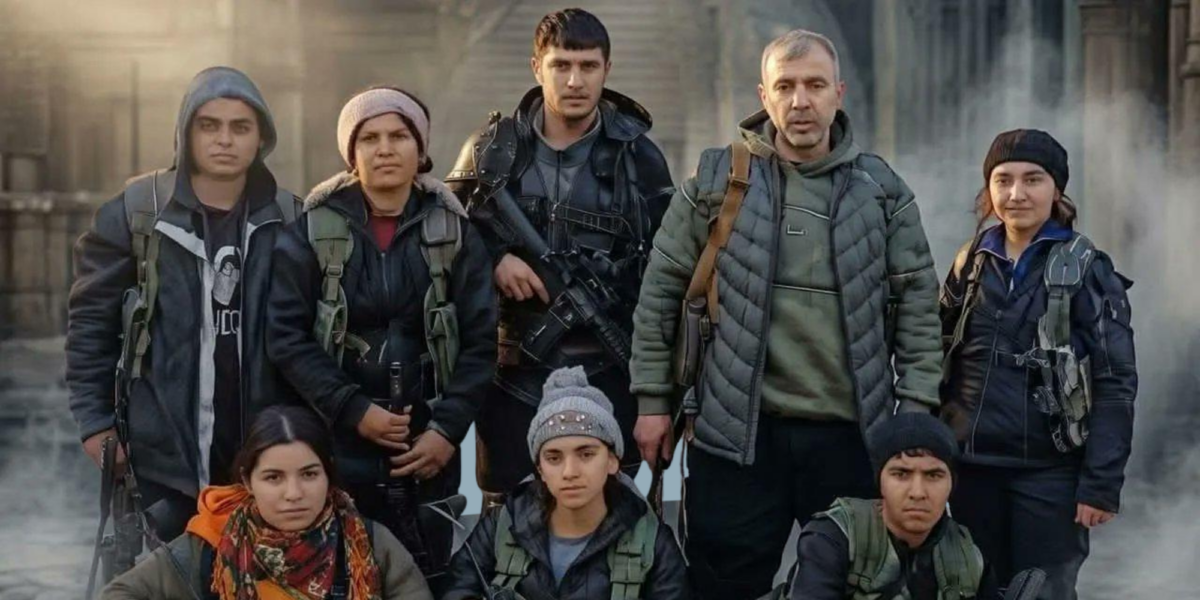
After their occupation by the Turkish state, many fled to the familiar city of Aleppo, but most went to Sheba, where they lived for eight years in self-governed tent cities. In times of material scarcity and poverty, these people created everything from nothing: with their solidarity and shared goal of a victorious return, they built a life that can truly be called vibrant, humane, and socialist. With their strong sense of community and mutual support, their organization in communes and people’s councils, their lovingly tended tiny tent gardens, and their cultural creativity and identity, they became examples of the values of the Rojava Revolution.
In 2024, with the fall of the Assad regime and the attacks by the al-Nusra gangs, the Afrin population was once again forced into exile. Without the slightest warning, from one day to the next, to protect the people from the gangs’ planned mass murder, we left our beloved Sheba. Wearing slippers, pajamas, and only the clothes we were wearing (some even gave these to the fighters to hide among their families and thus smuggle out, protected from the gang members’ view ) , we set off in three long convoys, under the cordon of ISIS, al-Nusra, and all the other scum, on our way to Tebqe.
December 2, 2024 ŞHEBA
I’m sitting opposite the gang members of Cep El-Nusra, or whoever else, hidden in the car that’s joined the convoy. If they knew who I was, what would they do to me? I think of Ş. Ronahî, Andrea Wolf, and draw strength. But around me are our loyal young people, mothers and fathers, all convinced to protect me and all our other friends to the very last. One mother wanted to give me her child until we left the gangs behind, but I didn’t accept that. How can you do justice to the love of a people who are willing to give up their own children for the safety of their role models and fighters? ‘Ceasefire’ until the 200,000 people are evacuated. The word burns like a wound on the skin, when all of us, including mothers and grandmothers, young people and fathers, were ready to fight, to resist. But from one day to the next, a state collapsed; the soldiers’ weapons hadn’t even clanged on the ground when they vanished, abandoning their people to the gangs. Once again, the superpowers played with the lives of thousands. Even before we joined the convoy, 28 women and children came walking towards us. They had been walking for two days, Arab families; their husbands were Syrian soldiers, also fleeing the gangs. I hugged the children and took them to the mosque. In their eyes, fear, and on their lips, the question: Who will protect us? Speaking broken Arabic, and with a translator, I assure you, we are Apoists, we are all peoples, we leave no one behind, for our goal is the dignified life of all. We will take revenge, just you wait. A bullet glows in my pocket. A father took it from his child’s hand and gave it to me, for this people knows that it is pointless to helplessly rely on others and that the strength to defend themselves is priceless.
December 15, 2024 TABQE
A person can lose their home and land, can even become homeless, make great sacrifices, and shed blood. But the moment faith and hope are shattered, that person and their people are in danger. War degrades, dehumanizes, tears apart the social fabric, and in crisis and chaos, it forces everyone to focus solely on their own survival. Yet it is the small moments that transform pain into strength. The true power of society to support and protect one another emerges in the most difficult moments. When people, children and the elderly, were still sleeping on the asphalt in the winter cold, when the chaos of tents, distribution, bread, and the sick seemed endless, when we all still said it was too soon to expect anything from humanity, the wise old ones shook us awake and set us on the right path. We wanted to organize communal kitchens and distribute the food to everyone. One mother laughed and said to me, “We’ve lost everything. If you take away our jobs too, what will be left of us?” An old man took me aside and said, “Keça min (My dear daughter), listen, we can’t stand arguing with our neighbors over a blanket or a bit of bread. It’s beneath us. That’s why my children have been sleeping in the cold for two weeks.
We need our communes back! Give us back our system, give us back our lives, and the problems will solve themselves! ” And they were right. In just one month, strangers became neighbors. The commune leaders have the most modest tents because they distribute everything to those most in need. The children are washed together in a makeshift tent bath and dried and warmed in another . The older generation organizes communal life; we young people are the driving force behind morale and change. By day, we are with families and in the communes, singing, telling stories, and listening. At night, with Kalashnikovs on our shoulders, we patrol in and around the camp.
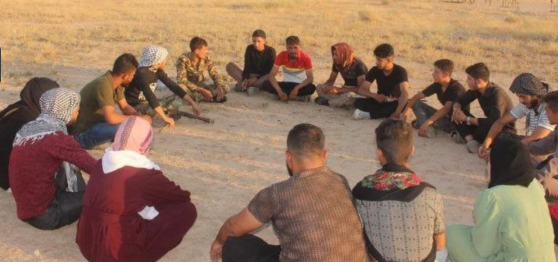
After two months, the young people gather the primary school children for daily Kurdish writing lessons so they don’t forget their mother tongue (contrary to the so-called aid organization that offers Arabic lessons, a language associated with coercion and assimilation for Kurds). In the third month, we founded the camp’s first dance group (first the young people, then the women, and then the older generation formed a group). It turned out that in war, the most important thing is to insist on humanity.
January 6, 2026. CIZIRE CANTON
Despite our persistent warnings that HTŞ offers no guarantees and the possibility of renewed war is high, many families have moved to overcrowded Aleppo of their own accord. Why there, and not to the far safer cities of Cizre, when they have only just recovered from the war experiences of Şehba? ‘Comrades, wherever you are, we will follow you; we can no longer breathe in an occupied country.’ And above all, because they cannot bear to be far from their beloved city of Afrin, always just a leap of faith away.
When the murderous gangs fired the first rockets at Aleppo, and the signs of inevitable war were unmistakable, the people of the two districts gathered once again to make a collective decision: retreat from their beloved and hard-won neighborhoods and flee from their merciless ‘allah û ekber’s? Or unwavering, collective resistance and a defensive war against the looming occupation and annihilation? However, without any guarantee of the outcome, a decision about life and death. But also about this: if life, how should one live? If death, what for? And they made their decision . When Rêber APO speaks of freedom as the willpower to decide, as knowledge of the meaning of history and the present, of one’s own place in the world, as the courage to take the right, self-sacrificing, heroic path, then this people and their freedom fighters are proof of that.
Once again, hegemonic fascist forces have played the game of redrawing maps and borders on our revolutionary land. The armies of two super-states, Turkey and Syria, along with intelligence services and soldiers disguised as HTŞ gangs, have launched a complete annihilation operation using every conceivable weapon and air power. Against them stood the force of just 300 fighters, armed only with small weapons. Using gas cylinders salvaged from kitchens, they blasted tanks to protect civilians from annihilation. With inhuman brutality, they did everything to break the will of this people, to sow fear in their hearts, and to defile their dignity. But once again, it was the heroes of this people who said: if life, then resistance; if death, then for dignity. And the courage of the martyrs who sacrificed themselves became the pride of the survivors. The body of the fighter, who for the Slafists represented the terror of death as a free woman, was thrown from the third floor of the building where she had stood alone for three days, before the eyes of the world. She was proclaimed an Angel of Dignity, and instead of the expected surrender, a people stood with their heads held high and declared: “For the vengeance of those who protected us and whom you disgrace, and for our humanity and dignity, we will fight for life to the very end.”
January 31, 2026. CIZIRE CANTON
After six days of tireless, fearless, and heroic resistance, a ceasefire is forced upon Rojava, as the number of wounded and dead continues to rise due to the attackers’ atrocities. Two days later, the ceasefire is broken once again, and the Arab cities east of the Euphrates become the targets of the occupying forces’ attacks. Their goal: to force Rojava to surrender, because Rojava is the beginning of a democratic Middle East with free women and diversity.
A war, an uprising. Betrayal and heroism. Brutal inhumanity and a tremor of dignity and solidarity. Rojava, the land of hope, the society of freedom, the struggle for dignity and for life. Like a volcano that erupted in Aleppo, the resistance has spread throughout the land, all four parts of Kurdistan, and out into the world, transcending borders. Everything is glowing, ready to burn, erupting from the very core of the world, from the very core of humanity, their truth, their dignity, and their love for a free life. We will not surrender, for resistance means life.
To insist on humanity means to insist on socialism.