By Colectivo Xwebûn, somewhere in central-western Brazil
Read in different languages: POR / ESP / GER
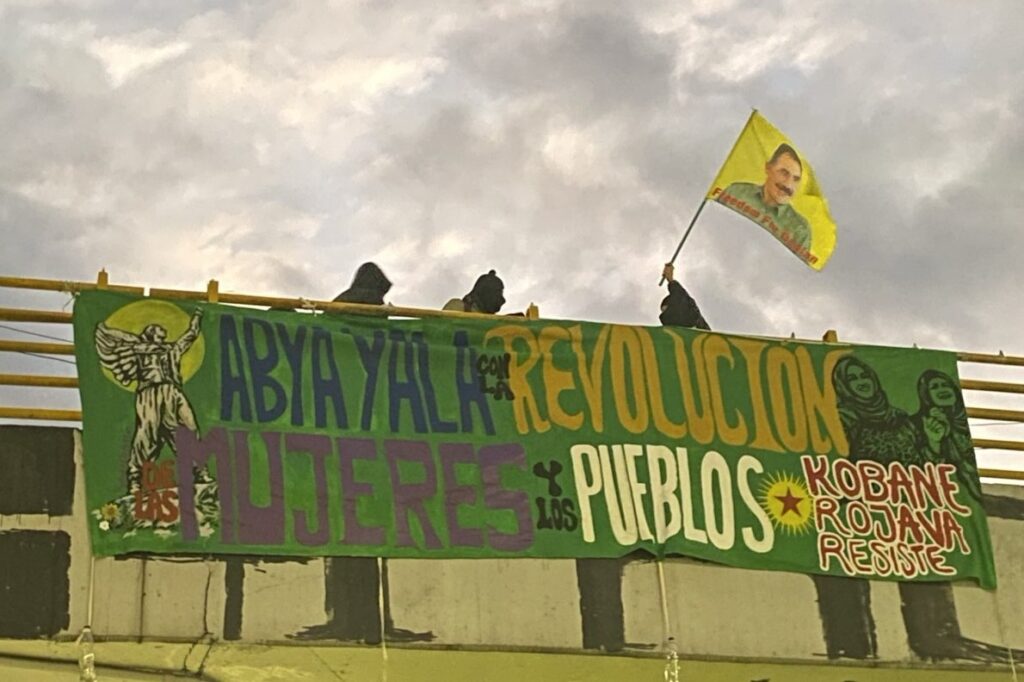
Greetings, comrades, I speak from the western border of the Brazilian state, where for two centuries a war of extermination has been waged against the indigenous peoples of this region, especially the Guarani and Kaiowá and all their martyrs—such as Vicente Fernandes Vilhalva, murdered on November 16, 2025, by the forces of the latifundio and its militias in the south of the state of Mato Grosso do Sul. For their part, the peoples are resisting by reclaiming their ancestral lands, challenging the large landowners, who are the foundation of the Brazilian state’s violence against the peoples, a state built on millions of indigenous and black bodies as a result of the long colonial wound that runs through us. It is from these territories in resistance, which are rising up against the new colonizers, that we are fighting as multiple, rebellious, and popular movements, sharing the voice and legacy of our martyrs in Brazil and Abya Yala with the martyrs in Kurdistan, the beacon of our common struggles for life. Thus, it is very important to remember the memory and struggle of Şehid Lêgerin, who gave her life for the revolution and paved the way for internationalism in Abya Yala and our own quest for freedom: her quest became collective.
From where we come from, we defend Rêber Apo’s paradigm to the end and little by little we weave paths of freedom with what we have learned from the Kurdish revolution and the liberation movement; We say to you, comrades who resist in Kurdistan, in Rojava, or in the mountains: your struggle is our struggle, and our hearts and souls are with you, even though we are so far away, in this moment of defense and liberation of humanity, with the vanguard shared among the peoples of the world who dared to say enough is enough. You are not alone. This week in Abya Yala we are starting many actions of solidarity, and we will not stop until victory is achieved. Rojava will win. Rojava’s victory is already a reality, confirmed by internationalist efforts, by encounters like this one, which make us feel that the thread woven from the mountains of Kurdistan is so strong and deep that with it we begin to weave and share our hands, our lives, and our dreams for a world where many worlds fit, as the Zapatistas say, colored with the paths of the Kurdish revolution involved in our daily practices and at the basis of collective action.
That said, and thinking again with the Zapatistas, the revolution in Kurdistan joins the popular uprisings in Abya Yala as cracks in the great wall of World War III, a metaphor that combines with the capitalist hydra as an image of the world-system, the driver of colonial “violent spoliation,” which returns to continue the “sea of blood and mud” it produces. The Zapatistas tell us that the wall changes its appearance. “Sometimes it is a large mirror that reflects the image of destruction and death, as if there were no other possible alternative. Sometimes it seems pleasant and a placid landscape emerges on its surface. Other times, it is hard and gray, trying to convince us of its impenetrable solidity.” The role we assume and share, comrades, is to make the cracks bigger. In these cracks, we look to you today to imagine everything that is possible to do now and tomorrow.
In Abya Yala, since the first European invasion in 1492, what began was a genocidal colonial project that eventually subjected the peoples to slave labor in mining and large sugar plantations. Capitalism, which was born on our continent without proletarians (Zibechi, 2022), was based on the attempt to destroy many non-capitalist ways of life, communal lives that they tried to massacre as a way of disciplining the people, of colonizing them through the ideology of race as the builder of the state itself, founded on the patriarchy that Europeans exported to expropriate the peoples of their own politics and existence. Some sources speak of more than 50 million deaths in this process. This does not mean that the peoples did not resist: the experience of the Quilombo dos Palmares in Brazil, which lasted a century between the 16th and 17th centuries, the Mapuche struggles that guaranteed the autonomy of Wallmapu, their ancestral territory until the 19th century, and all the indigenous wars against the colonizers, are examples of the spirit that still drives us forward.
The situation we find ourselves in today is one of extractivist consensus, which is also a patriarchal consensus established by this long process of colonization led by white men, which sustains the governments of states that claim to have gained independence from European metropolises through the organization of commodity chains. These, in turn, through the agrarian bourgeoisie of the countries of Abya Yala, control large portions of land and, especially at this moment, seek control over what is produced, rather than direct ownership of the land (Adoue, 2025). Their advance into lands that have not yet been commercialized is rapidly encroaching on public and collective lands, whether for mining/garimpo, monocultures of genetically modified soy/corn and eucalyptus/pine, or livestock, among other forms of extractivism in the country—and throughout the continent.
There is a new dynamic in extractivist chains, with new strategies, which is the integration of indigenous, quilombola, and other traditional peoples’ lands, as well as agrarian reform settlements and family farming, for the production of commodities. There are variables, for example, in the Amazon with garimpo (small-scale mining) and, even more recently, with carbon credits. The effort of the chains and their representatives in the government is now to relativize the legal frameworks for land use, as has happened with successive governments in a more accelerated or gradual manner. This dynamic of degradation and dispossession is against the people. The prices of goods produced on the land are fluctuating, which explains why it is advantageous, for example, to rent land rather than tie up capital in its purchase—a consequence of the financialization of agriculture.
This pressure requires large companies and different points in the extraction chain to deepen their political and military strength and close ties with public authorities. Since the 1850 Land Law in Brazil, for example, when land ownership through purchase or inheritance was legalized, the business opportunities created by the increased demand for inputs for the second industrial revolution in Europe and the United States led to the intensification of large-scale production through the concentration of land ownership. At that time, the ancestral lands of indigenous and traditional peoples were considered illegal, and legal conditions were created to expel these people, intensifying genocide (Adoue 2025)1 . Canudos (1896-1897), at the end of the 19th century, is an example of the first popular uprising faced by the Brazilian republic’s army. Although harshly massacred, the spirit of Canudos continues to inspire generations of fighters, as do the great indigenous revolts of that time.
What is happening right now reactivates the dispossession of ancestral and traditional lands of their legal guarantees and allows them to be transformed directly into assets for the global market. Furthermore, the recent invasion and aggression against Venezuela by the US is a model for what is happening and will happen throughout Abya Yala, plotted by the ongoing Palestinian nakba, the attacks against Rojava, and the new partition of the so-called Middle East. The recent massacre in Rio de Janeiro, with hundreds of deaths, and the recent massacres against indigenous, traditional, and peasant peoples also add to this scenario, carried out by state military forces, landowner militias, and drug traffickers with the direct support of many sectors of the Brazilian state. But we know that the forces behind this are the same imperialist forces that are currently attacking Rojava, such as the United States and Israel—one of the largest exporters of agricultural fertilizers for Brazilian extractivism and also of military technology, the same technology that attacks people in the favelas and indigenous and traditional territories.
But, to paraphrase Silvia Adoue, indigenous peoples emerge as ontological, cosmopolitical, and material barriers against the integration of territories into extractivist chains. Today there are 391 indigenous peoples and around 294 indigenous languages in Brazil. How can their struggles for land and freedom be coordinated? The paradigm of democratic confederalism may be a possible path. These peoples, as Öcalan told us, or “natural societies” in his theory, followed the river of democratic modernity, where the “values of democratic society resist” through space-territories, territories of existence that are real alternatives to capitalist modernity, spaces of action and reproduction of life where other social relations are established. Nego Bispo, Antonio Bispo dos Santos, quilombola master and fighter for Mother Earth who joined his ancestors in December 2023, says that he needed to “reach the source of humanity, because no one knows the river through a flood: the flood is temporary. If you look at the flood, you don’t know the river. You can know the river if you know its source, which is what gives the river its permanence and flow: in other words, you cannot understand the paths of a people without understanding the source of their journey, where this people comes from”2 .
Therefore, this nascent movement embodies the values of democratic modernity, defended in our country and continent by many ongoing rebellions, such as the retomadas. The retomada, an act of reclaiming land and territory, is a movement and category specific to the indigenous peoples of Brazil, with women at the forefront, which can extend to other traditional peoples and communities (e.g., the quilombolas), beyond state borders. Peoples as diverse as the Guaraní and Kaiowá, Terena, Kinikinau, Mbyá Guaraní, Xokleng, Kaingang, Tupinambá, Pataxó, Pataxó Hã-Hã-Hãe, Kariri Xocó, Munduruku, Gamela, avá canoeiro, xukuru kariri, Maxakali, Kamakã Mongoió, Mura, among others, have historically carried out land recoveries throughout the country, claiming autonomy, demarcation, or self-demarcation of their ancestral territories. In other parts of the Latin American continent, recoveries are called territorial recoveries, such as those carried out by the Mapuche people.
Through the direct recovery of the claimed territory (or part of it), indigenous peoples return to areas of traditional occupation that have been taken over by non-indigenous people who acquired the land with the consent of the state and the historical weight of colonization. These are, therefore, “collective actions aimed at definitively reestablishing indigenous possession of the traditional areas that were expropriated from them” (Cardoso, 2018).
Since the beginning of colonization, they have been part of the counter-colonial confrontations with Euro-Christian cosmophobia, as Nego Bispo also points out. They arise to recover forms of coexistence and cohabitation affected by the violence of European invasions in Abya Yala. The recovery is not strictly of the land, but intertwines memory, relationships, knowledge, practices, bonds, language, art, ecological regeneration, identity, politics, food, landscape, and countless other dimensions of collective existence threatened, usurped, or interrupted by white “land-forest eaters.” (Albert, 2015:334).
In this sense, recoveries are involved in defending life and, therefore, as forms of resistance against the siege of the common good, of the reproduction of life. The experience of these antagonisms occurs in the field of their impossible coexistence, of the critical and conflictive spatiality occupied by large estates and neo-extractivism that put pressure on indigenous and traditional territories. It is important to remember that, seven years ago today, the mining company Vale committed a crime in the Brumadinho region of Minas Gerais, killing 272 people and leaving a trail of destruction, toxic sludge, dead rivers, and many sick people. In the recovered territories, on the contrary, it is possible to replant, allow the regeneration of degraded areas, and move towards food, energy, water, and educational autonomy, as well as in the areas of health and collective care, self-defense, and others, against these projects of death against our lands. The retomas are a rejection of the dependencies and scarcity generated by the capitalist and patriarchal way of life, creating an effect of recomposition of the land and all its relationships.
It is precisely this set of factors that places the retomas in a war of worlds, committed in their collectivities to the revitalization of counter-power exercises, counter-institutions, and other forms of reproduction of life that contrast with the modes of being imposed by colonization.
The rebellious poetics of the retomas herald the power of other relationalities and ways of doing politics that we identify with deep links also in Rojava and the Democratic Autonomous Administration. Their insurgent character opens up a crossroads of futures and counterpowers based on ancestry, as insurgent territorialities weaving the worlds that emerge from the ruins of capitalism.
These poetics are in harmony with Rojava; these poetics—or cosmopoetics—are what unites our lives and what made it possible to resist five centuries of colonization in Abya Yala and thousands of years of state and patriarchal domination in Mesopotamia. Tomorrow, on the 11th anniversary of the liberation of Kobane, we affirm: Rojava is invincible, invincible like the lands and ancestral strength of our people, who root hope in the Apoist spirit as a bridge to new luminous dawns. Other Rojavas are already being born.
Long live the resistance of Rojava!
Long live Rêber Apo!
1 https://desinformemonos.org/brasil-por-tierra-y-territorio-de-retomadas-y-recuperaciones/.